
Three-Hole Razor Blades: Common Uses in Film and Packaging Cutting

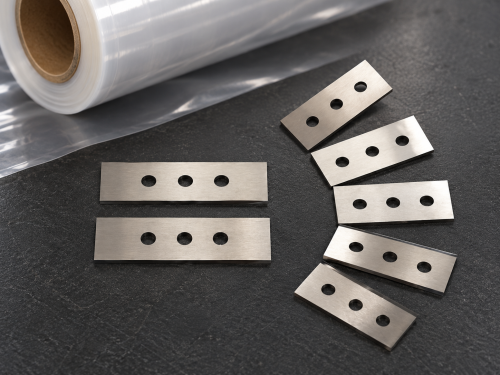
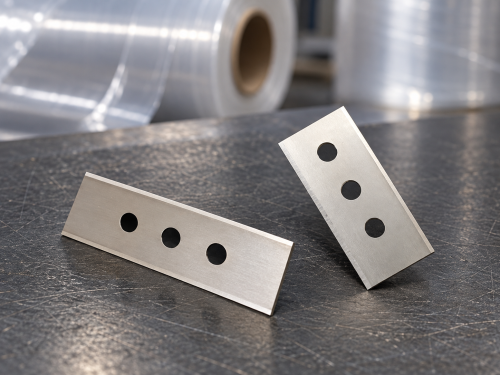
Three-hole razor blades earn their keep on packaging and film-converting lines by slitting, perforating, and notching flexible substrates at speeds where a standard two-hole blade would chatter or shift. The extra center hole locks the blade against a mid-point pin, keeping the edge dead-straight even when the line is running film at 300 meters a minute. If your machine specs call for a three-hole pattern, it’s almost always because someone needed more positional stability than a two-hole design could deliver.
Why the Third Hole Actually Matters
Most people assume the third hole is just extra mounting redundancy. It’s not — it’s a stability fix for a real problem.
A two-hole blade is only pinned at its ends. Under vibration or uneven tension, the middle of the blade can flex or twist slightly, even by a fraction of a millimeter. On slow equipment that flex never shows up. On a film slitter running at high speed with tight web tension, that same flex turns into wavy cut edges, micro-tears, or a blade that walks out of its slot mid-shift.
The center hole in a three-hole razor blade pins the middle of the blade against a third locating pin in the holder. That third contact point kills the flex. The blade stays exactly where it was set, shift after shift, which is why converters running printing, paper and nonwoven web handling systems tend to specify three-hole blades once line speeds climb past a certain threshold.
Film Slitting: The Most Common Application
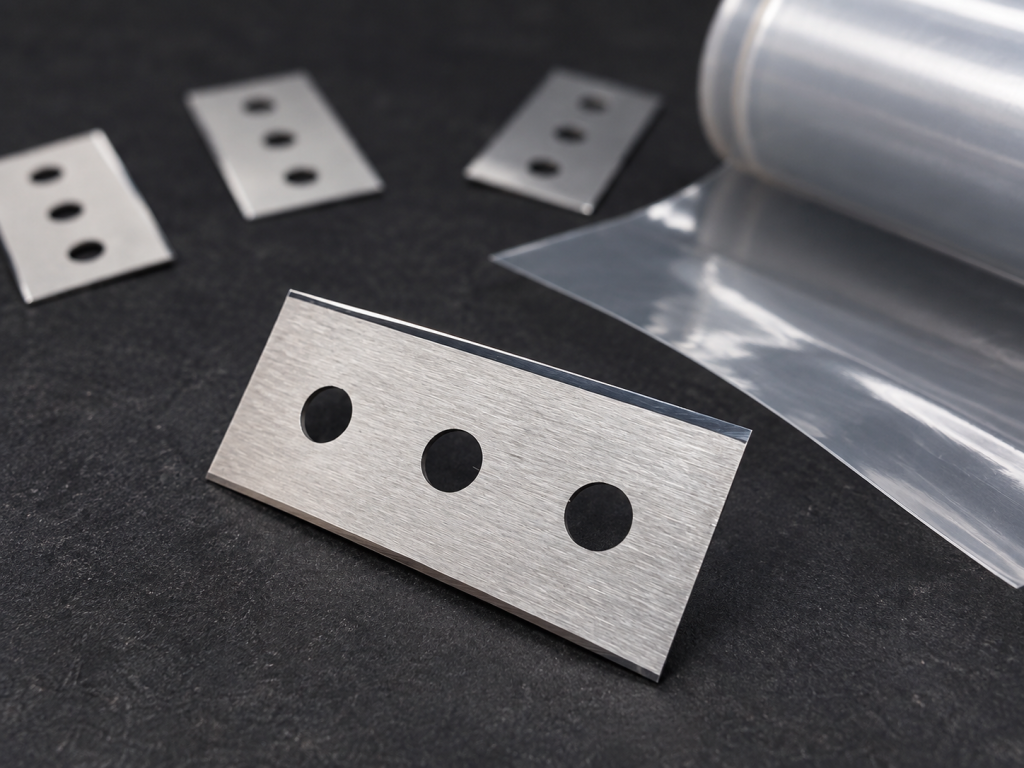
The single biggest use case for three-hole razor blades is longitudinal film slitting — cutting a wide roll of film into narrower strips as it unwinds continuously.
Think of a plastics processor running blown LDPE film at 250 m/min, slitting a 2-meter master roll into eight 25 cm strips for a customer’s bag-making line. Each slitting station holds a small razor blade under tension against the moving film. If the blade shifts even slightly, you get a wandering slit line, uneven strip widths, or edge fraying that shows up as customer complaints three weeks later.
Three-hole blades hold their slit position tightly enough that operators can run entire shifts without re-checking alignment. For thinner films — under 30 microns — this stability difference between two-hole and three-hole blades becomes very noticeable in scrap rates.
Bag Machine Notching and Tear-Point Cutting
Ever pulled a perfectly straight notch off a bag of chips or a courier mailer? That clean little tear-start notch is almost always cut by a three-hole razor blade mounted on a rotary or reciprocating notching head.
Bag-making machines run at high cycle rates — often several hundred cuts per minute — and the notch has to land in exactly the same spot on every single bag. A blade that drifts by even 1 mm creates a notch that either doesn’t tear cleanly or cuts too deep and weakens the seal. The three-hole mount is standard here specifically because the repeatability requirement is unforgiving.
For OEMs designing new bag machines, blade geometry and hole spacing have to match the holder tolerance exactly — this is where working with a supplier who does OEM/custom blade design based on your machine specs saves a lot of trial-and-error.
Label and Release Liner Trimming
Label converting is another quiet but high-volume user of three-hole razor blades. When a die-cut label roll needs its edge trimmed clean, or the liner needs a matrix strip removed, a stationary or oscillating razor blade does the trimming.
Label stock is thin and often coated, which means the blade edge has to be sharp enough to shear cleanly without dragging adhesive residue across the cut. Any blade instability shows up instantly as a fuzzy or torn liner edge — something quality control catches fast because labels are inspected under bright light at the customer’s end too.
Converters running mixed substrates — paper labels one week, film labels the next — often keep a stock of three-hole blades in a couple of edge angles ready to swap in, rather than re-sharpening on the fly.
Packaging Machine Score and Perforation Lines
Not every cut needs to go all the way through the material. Perforated tear lines on shrink film, cereal box liners, or blister pack backing all rely on a razor blade set to partial-depth contact, and three-hole blades are common here because the perf pattern has to repeat exactly across thousands of cycles.
A common mistake: operators assume any sharp blade works for perforation. It doesn’t. Perf blades need a controlled, consistent edge geometry — too aggressive and the material tears apart before it’s even packed; too shallow and the tear-line doesn’t work at all for the end customer. This is a case where matching blade spec to material thickness matters more than raw sharpness. Our guide on choosing the right industrial blade material covers how substrate and thickness should drive that decision.
Where a Three-Hole Blade Is the Wrong Choice
Three-hole blades aren’t universal. On slower, lower-tension applications — hand-fed tape dispensers, low-speed cardboard scoring, or simple manual trimming jigs — a standard two-hole blade does the job just fine and costs less to replace.
They’re also the wrong pick when the holder itself only supports a two-point pin pattern; forcing a three-hole blade into a two-hole slot (by ignoring the center hole) defeats the entire purpose and can actually cause uneven seating. If you’re retrofitting a machine, always confirm holder pin spacing before ordering a batch of three-hole blades — it’s a five-minute check that avoids a wasted order.
Matching Blade Thickness and Edge Angle to the Job
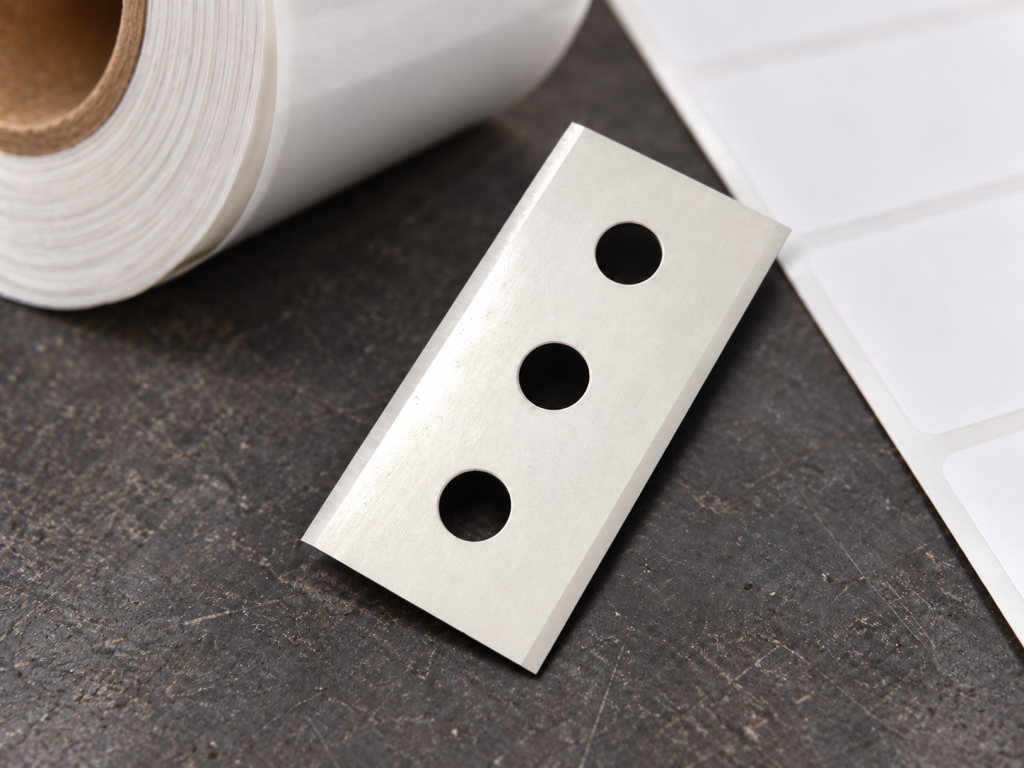
Thickness and edge angle matter as much as the hole pattern. A 0.30 mm blade with a 22-degree edge suits light film slitting; a heavier 0.50 mm blade with a stronger bevel handles thicker laminates or coated substrates without chipping.
For example, a nonwoven packaging producer switching from single-layer PE to a laminated PE/PET structure often finds their old blade spec starts chipping within days — the fix usually isn’t a different hole pattern, it’s a thicker blade stock with a tougher edge angle. Getting this wrong is one of the most common causes of unexplained burr formation, which we break down in more detail in why your slitting line produces burrs.
Quick spec checklist before ordering
- Confirm holder pin spacing and hole diameter match exactly
- Match blade thickness to substrate stiffness, not just cut speed
- Specify edge angle based on whether the cut is full-through or partial (perf/score)
- Request a small trial batch before committing to volume, especially on a new substrate
Keeping Three-Hole Blades Consistent Across Repeat Orders
The single biggest complaint we hear from packaging OEMs isn’t about the blade itself — it’s about batch-to-batch inconsistency. A blade that cut perfectly last quarter suddenly starts leaving fuzzy edges this quarter, and nobody can pin down why.
Usually it traces back to inconsistent heat treatment or grinding tolerances between supplier batches. That’s why hardness control and CNC grinding precision matter more than most buyers realize when sourcing three-hole blades at volume — a supplier running tight process control should be able to hold hardness within a narrow HRC range order after order. If you’re dealing with drifting quality, it’s worth reviewing storage and handling practices too, covered in our guide on extending industrial blade service life.