

Bread Slicer Blades: Common Types, Machine Compatibility, and When to Replace Them

Bread slicer blades come in two main forms — reciprocating corrugated blades and continuous band blades — and each one is built for a specific slicing motion, not interchangeable across machine types. Get the type wrong and you'll see crumbing, torn crust, or jammed lines within days. The real question isn't just 'which blade fits,' but 'how do I know mine is worn out before it starts wrecking product.'
The Two Blade Types Bakeries Actually Use
Walk into any commercial bakery and you'll find one of two blade systems doing the cutting. They're not interchangeable, and mixing them up is the single most common sourcing mistake we hear about.
Reciprocating corrugated blades
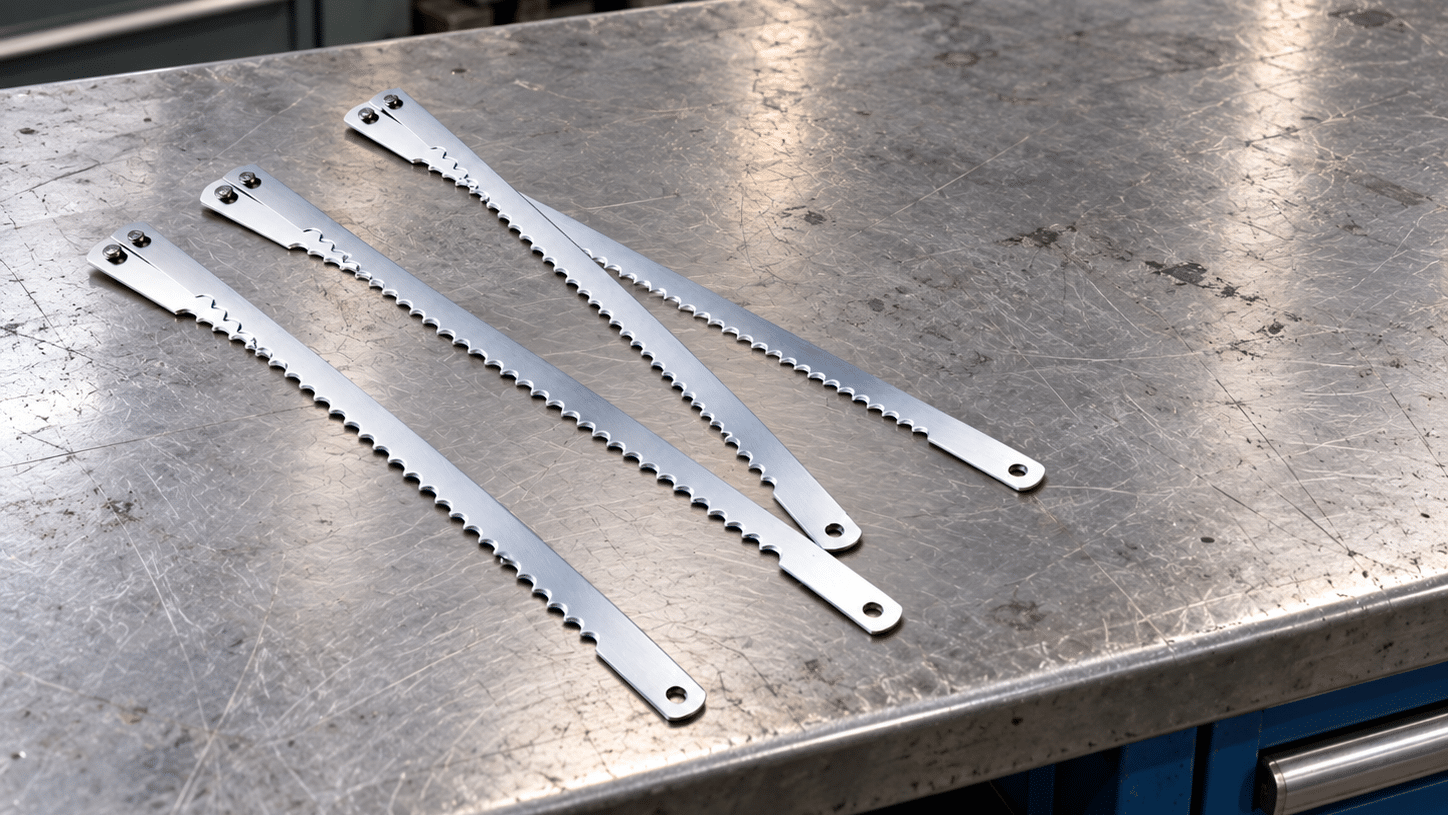
These are thin, wavy-edged blades mounted in a gang frame that moves back and forth through the loaf. The corrugation (wave pattern) is what lets a thin blade grip soft, low-density bread without tearing it apart. Most industrial gang slicers — the kind cutting hundreds of loaves per hour for sandwich bread — use this style.
Band or loop blades
A continuous serrated band running on pulleys, similar in concept to a band saw. These show up in continuous-motion slicing lines where throughput matters more than delicate handling. For a broader look at how blade geometry changes across food-grade cutting, our food processing blade category breaks down the material and edge options in more detail.
Matching Blade Type to Machine Model
Here's a mistake we see constantly: a maintenance buyer orders 'bread slicer blades' by loaf size instead of by machine spec, and the batch doesn't fit the mounting holes or the corrugation pitch is wrong for the frame tension.
What actually matters for compatibility:
- Mounting hole pattern and spacing — even a 2mm difference means the blade won't seat correctly in the gang frame.
- Blade length and thickness — reciprocating blades typically run 0.5-0.8mm thick; too thick and you get compression instead of a clean slice.
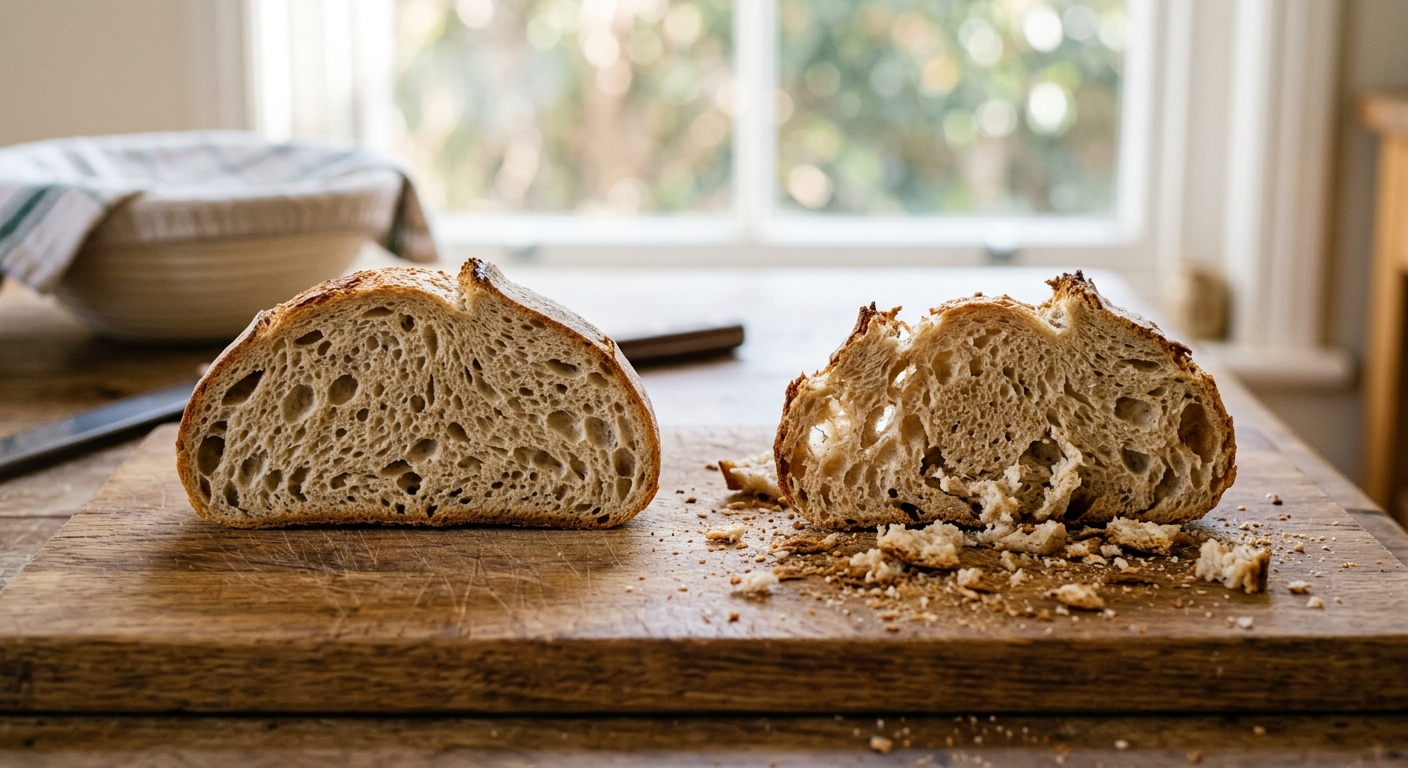
- Corrugation pitch — the wave frequency needs to match the bread's crumb density. Dense rye needs a tighter wave than fluffy white bread.
For instance, a mid-size bakery running an older Oliver or JAC slicer often finds that generic aftermarket blades technically 'fit' the frame but have the wrong corrugation pitch for their specific bread formula — leading to excess crumbing that wasn't happening with OEM blades. This is exactly the kind of detail a custom blade supplier needs upfront; our guide on what your blade supplier needs before quoting covers the full spec list.
Material Choice: Why Stainless Isn't Always the Full Answer
Stainless steel is the baseline for any food-contact blade — that's not up for debate on sanitation grounds. But stainless grade and heat treatment vary a lot, and that's where wear life actually gets decided.
High-carbon stainless (like 420 or 440 series) holds an edge longer than basic 304 stainless but needs proper hardness control during manufacturing — typically 52-58 HRC for bread slicing applications. Go too hard and the thin corrugated edge chips on crust contact. Go too soft and you're regrinding every few weeks.
For lines handling multigrain, seeded, or glazed loaves, the edge finish and corrosion resistance may need closer review because seeds and coatings can accelerate wear. Share the recipe and cleaning process with your blade supplier so the material and finish are selected for actual production conditions. For a deeper comparison of blade materials across industries, see our piece on choosing blade material: steel vs carbide vs ceramic.
Wear Signs That Actually Mean 'Replace This Now'
Most bakeries wait too long to swap blades because the failure isn't dramatic — it's gradual crumb quality decline that gets blamed on the dough recipe instead of the blade.
Visible signs
- Rounded corrugation peaks — the wave pattern should feel sharp to the touch; if it feels smooth, it's dulled.
- Micro-chipping along the edge, especially near crust contact points.
- Discoloration or pitting from cleaning chemical exposure.
Product-based signs
- Increased crumbing on the cutting table — a sharp blade separates crumb, a dull one compresses and tears it.
- Uneven slice thickness across a single loaf.
- Slower feed speed required to get a clean cut (a real sign the blade is dragging, not slicing).
A good rule of thumb: if you're adjusting machine speed or tension to compensate for cutting quality, the blade — not the machine — is usually the problem.
Sharpening vs. Replacing: The Real Cost Math
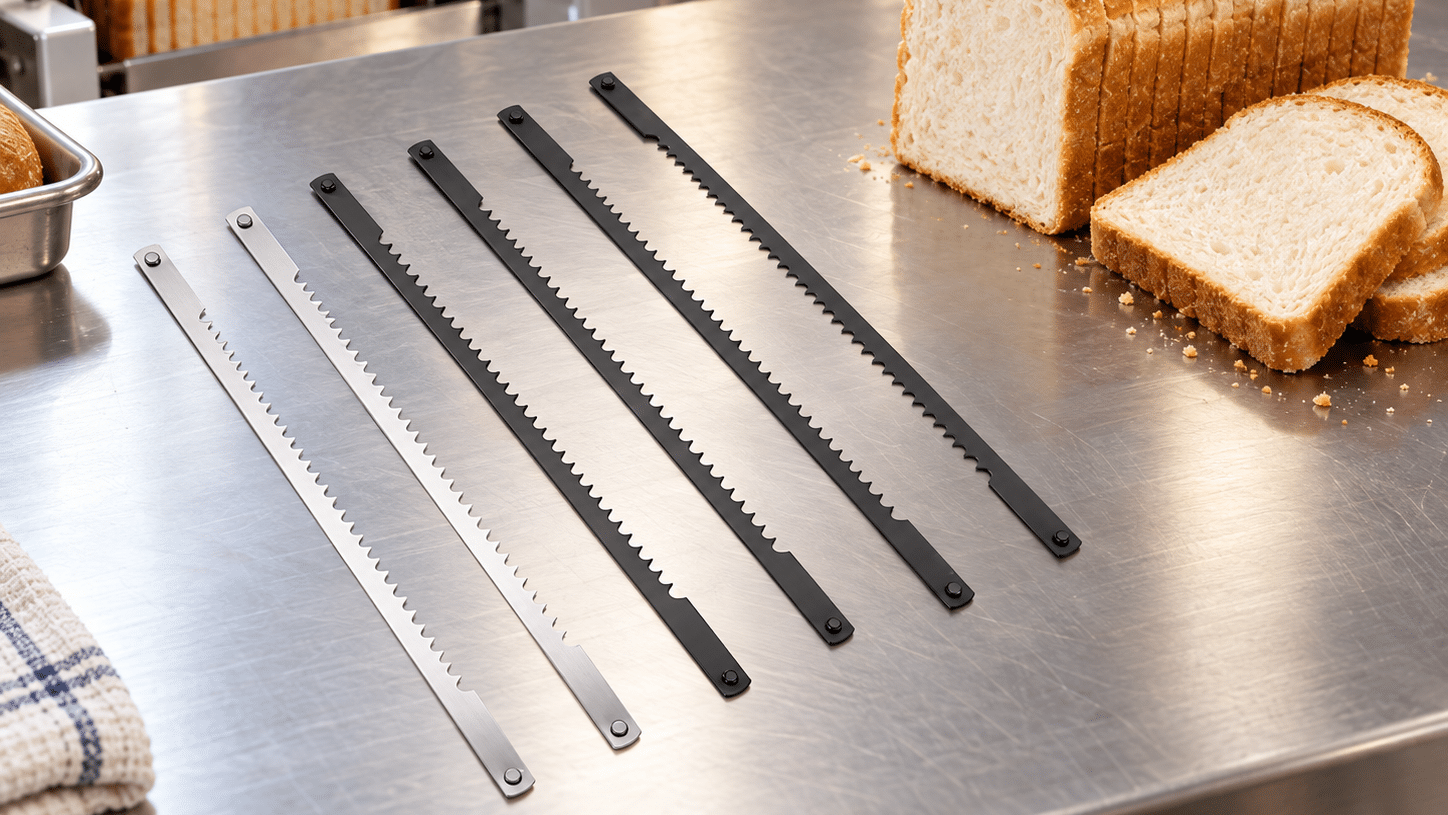
Regrinding extends blade life, but it's not free and it's not infinite. Each regrind removes a small amount of material, and after 4-6 cycles most corrugated blades lose enough wave depth that they need full replacement anyway.
A practical guideline: track cut count or run hours per blade set, not calendar time. A high-volume gang slicer running three shifts might need a regrind every 3-4 weeks, while a lower-volume specialty line stretches that to 2-3 months. Our detailed breakdown on sharpening intervals, wear patterns, and proper blade storage applies directly here — the same wear-tracking logic used on packaging and recycling blades holds for bakery lines.
One thing worth flagging: cheap blades that seem like a bargain upfront often cost more over a year because they need regrinding twice as often and hold tolerance poorly after the second cycle. If your team is comparing quotes on price per blade alone, ask for expected cut-count life instead — it's a better apples-to-apples number.
Custom vs. Off-the-Shelf: When It's Worth Going Custom
Standard blades work fine for standard bread. But once you're running seeded loaves, gluten-free formulas with different crumb structure, or an older machine with a discontinued blade spec, off-the-shelf options start falling short.
Custom blade design makes sense when:
- Your machine is older or imported and OEM blades are slow or expensive to source.
- Your product line includes multiple bread types needing different corrugation profiles.
- You're seeing consistent quality issues traceable to blade geometry rather than dough or oven settings.
A factory that can run small-batch prototypes before committing to volume production is genuinely useful here — it lets you validate a new corrugation pitch on 50 units before ordering 5,000. That trial-order approach removes most of the guesswork from switching blade specs.
Storage and Handling Between Uses
A surprising number of 'blade failures' are actually storage failures. Corrugated blades are thin and flexible — stack them carelessly and you get warping that no amount of sharpening fixes.
Best practice is flat storage in individual sleeves or slotted racks, away from moisture and cleaning chemical residue. Blades left wet after washdown corrode at the corrugation valleys first, since that's where liquid pools. A five-minute dry-and-rack routine at shift end adds meaningful months to blade life — cheaper than any regrind.


