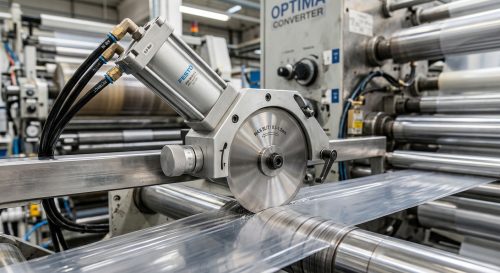

Film Slitting Blades: Choosing the Right Blade for Plastic Film, Foil, and Laminates

The right film slitting blade choice comes down to matching cutting geometry to substrate stiffness and layer structure — a thin razor blade that slices PE film beautifully will tear, drag, or generate static on a foil-laminate combo. Get the blade type, edge angle, and material wrong, and you’ll see curled edges, dust fines, or delamination at the slit line, even if everything else on the line is dialed in. This guide breaks down which blade style fits which substrate, so you stop treating film slitting as an afterthought.
Why Film Slitting Isn’t Like Cutting Paper or Metal
Here’s a mistake we see constantly: buyers spec a film slitting blade the same way they’d spec a paper slitter — thin, sharp, done. But film behaves nothing like paper under a blade edge. It stretches before it shears, it generates static charge that pulls dust and fines back onto the web, and thin gauges (below 20 microns) can actually deflect around a blade edge instead of cutting cleanly.
That deflection is the root cause of most “fuzzy edge” complaints on plastic film lines. The blade isn’t dull — it’s the wrong geometry for a substrate that wants to stretch rather than shear. Foil adds another wrinkle: it’s soft enough to crush rather than cut if your edge angle is too blunt, but brittle enough to crack and flake if the angle is too aggressive.
The Three Variables That Actually Matter
- Substrate stiffness — flexible film needs support (anvil or shear-style cutting), rigid laminate can handle a straight razor pass
- Layer count — multi-layer laminates need enough edge sharpness to get through every layer at the same shear force
- Line speed — faster lines generate more heat at the cut point, which softens some polymers and dulls blades faster
Razor Blades: The Default for Thin PE and PP Film
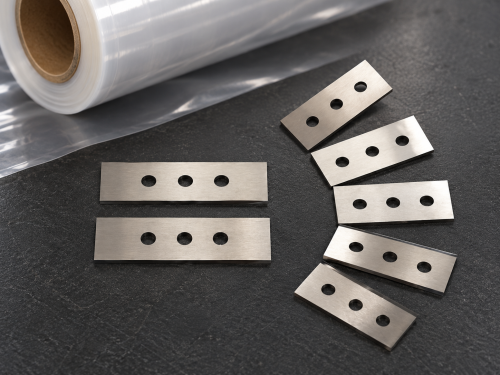
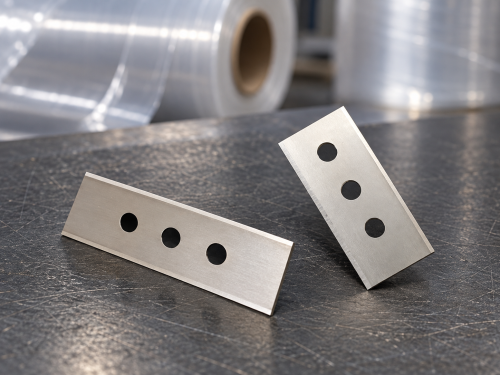
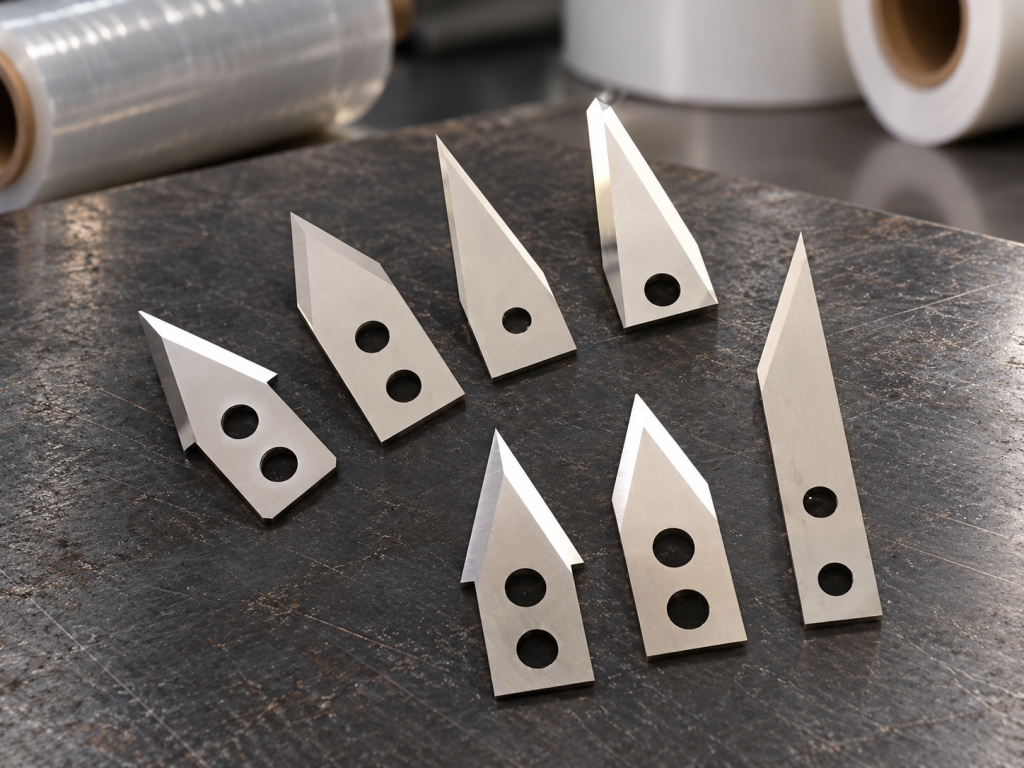
If you’re slitting unfilled PE or PP film under 50 microns, a razor-style trim blade is usually your best and cheapest option. These are single-bevel, disposable-style blades mounted in a holder, typically running a 22-30 degree edge angle against a rubber or steel anvil.
They’re fast to change, inexpensive per unit, and produce a clean edge on soft, unfilled polymer — but they wear quickly on anything with mineral filler (calcium carbonate-loaded film, for instance) or on coated film where the coating abrades the edge. A packaging OEM running high-speed PE bag film might change razor blades every 4-8 hours; that’s normal, not a failure.
Where razor blades fall short is on laminates. Push a razor blade through a PET/foil/PE laminate and you’ll often get delamination right at the cut line because the blade shears the layers at different rates.
Circular Shear Blades for Laminates and Multi-Layer Film
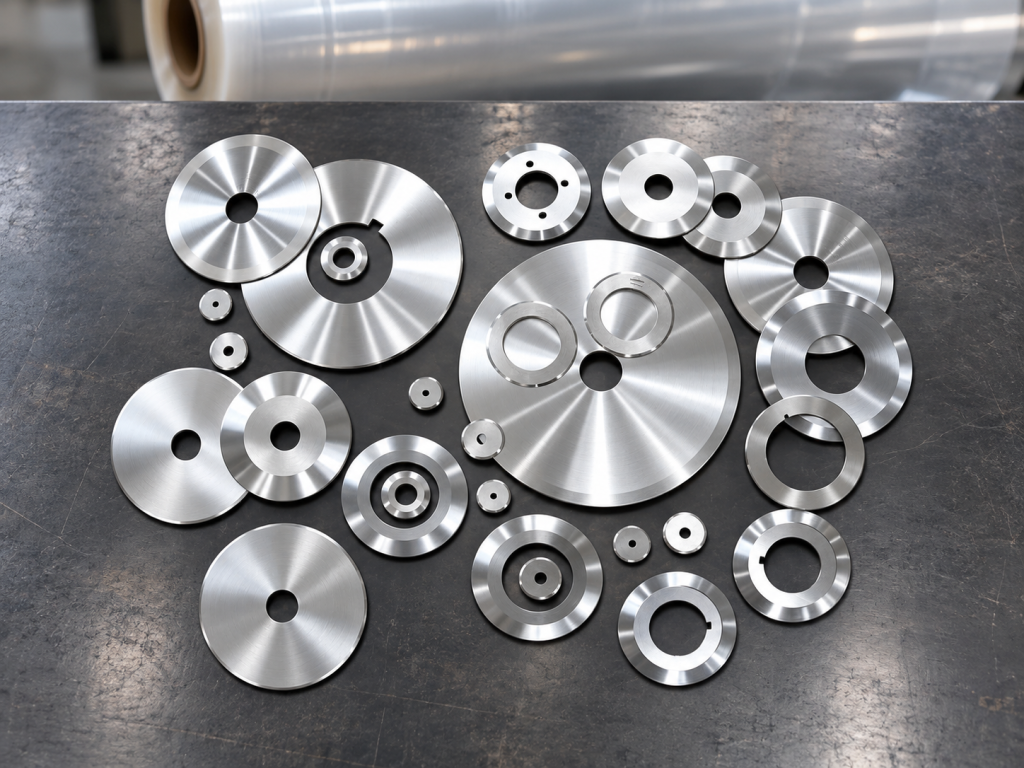
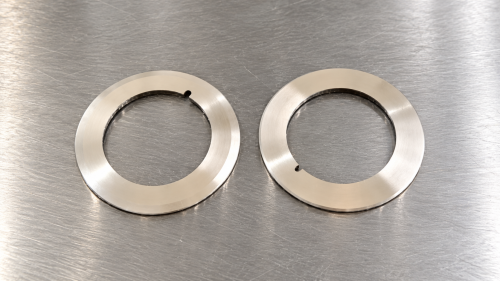
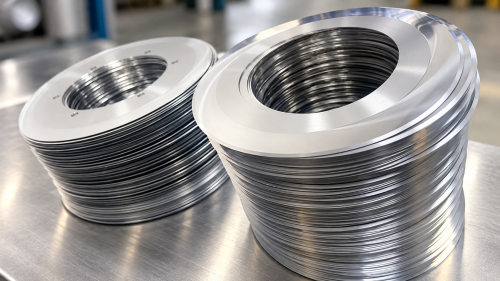
For laminates — PET/foil, BOPP/metallized film, multi-layer barrier film — a circular shear-style slitter (top blade against a bottom blade, overlapping like scissors) beats a single razor edge almost every time. The shearing action pulls both blades through all layers simultaneously at a consistent force, which is exactly what prevents delamination.
Setting the Overlap Correctly
The overlap between top and bottom blade is everything here. Too much overlap and you get excess wear and heat buildup; too little and the film pushes through without shearing, leaving torn or whiskered edges. As a starting point, most laminate converters run 0.1-0.3mm of overlap depending on total laminate thickness — but this needs fine-tuning per material, and it’s worth discussing with your blade supplier before your first production run.
This is also where matching blade material to substrate becomes critical — a laminate with metallized foil layers is more abrasive than plain film and will chew through a standard steel blade faster than you’d expect.
Foil and Foil-Laminate Combinations Need a Different Angle Entirely
Foil is deceptively tricky. It’s soft — you’d think any sharp edge would cut it easily — but pure foil under 15 microns actually crushes and folds under a standard acute-angle blade instead of shearing cleanly. That’s why foil converters often use a blunter score-and-crush geometry, sometimes 60 degrees or more, paired with firm anvil support.
For instance, a flexible packaging convertor cutting aluminum foil laminated to PE for snack food pouches found their edges were consistently curling and creasing rather than cutting clean. Switching from a 25-degree razor blade to a 45-degree shear-style blade with a harder anvil backing solved it — the crease disappeared because the foil was being sheared against resistance rather than pushed and folded.
Bare foil without lamination is rare in most converting operations, but when you do run it, treat it more like a metal-cutting problem than a plastic-cutting one. Our team also handles this crossover regularly for customers moving between metal shearing applications and foil converting — the physics overlap more than people expect.
Blade Material: Where Most Buyers Overspend or Underspend
High-carbon steel is fine for clean, unfilled film at moderate speeds. But the moment you introduce filled film, coated laminate, or metallized foil, that steel edge dulls fast — sometimes within a single shift. Tungsten carbide-tipped or solid carbide blades cost more upfront, often 3-5x the price of steel, but on abrasive substrates they can run 5-10x longer between changes.
The math is straightforward once you track it: if a steel blade needs replacing every 6 hours and a carbide blade lasts 40 hours on the same abrasive laminate, the carbide blade wins even at a premium price — fewer changeovers, less downtime, less scrap during the changeover window. For a deeper breakdown of when each material actually pays off, see our guide on steel vs carbide vs ceramic blades.
When Ceramic Makes Sense
Ceramic edges show up less often in film slitting, but they’re worth considering for ultra-high-speed lines running non-abrasive film where heat buildup — not abrasion — is the main wear driver. Ceramic holds an edge at higher temperatures than steel without the cost jump of carbide.
Static, Dust, and Edge Curl: The Symptoms That Point to the Wrong Blade
If your slit edges are curling upward, that’s usually a sign your blade angle is too shallow for the film’s stiffness — the film is bending away from the edge instead of shearing against it. If you’re seeing fine plastic dust accumulating along the slit line, that’s often a static issue made worse by a dull or improperly ground edge generating friction heat.
Burrs are a slightly different animal and usually point to blade-to-anvil clearance rather than blade choice itself — we cover that in detail in our post on slitting line burrs and blade-related fixes. But if you’ve already ruled out clearance and you’re still seeing edge defects, it’s worth stepping back and asking whether the blade type itself — razor vs. shear vs. score-crush — actually matches your substrate.
Working With Your Blade Supplier: What They Need to Know
Don’t just send a machine model number and expect a good blade recommendation. A supplier needs the substrate composition (single layer or laminate structure), thickness in microns, line speed, and — critically — whether the film contains fillers, coatings, or metallization. Skip any of these and you’ll likely get a generic recommendation that underperforms.
This is the same logic we walk through for food processing customers in our custom blade quoting checklist — the principle holds across industries: more upfront detail means fewer trial-and-error rounds. At Yishi Machinery, we typically recommend starting with a small trial batch on a new substrate before committing to volume production, since even a well-informed geometry choice sometimes needs a small tweak once it’s running on your actual line.