

OEM Blade Sourcing Guide: How to Qualify a Factory Supplier for Custom Machine Knives

Qualifying a factory supplier for custom machine knives comes down to three non-negotiable factors: verified manufacturing capability, consistent dimensional accuracy, and transparent quality control documentation. OEM buyers who skip the qualification process routinely face mid-production blade failures, costly line stoppages, and re-sourcing delays that erode project margins. This guide gives procurement engineers and OEM equipment manufacturers a structured framework to evaluate and select the right blade factory before placing a production order.
| Criteria | Commodity Blade Vendor | Qualified Factory Supplier |
|---|---|---|
| Dimensional Tolerance | ±0.1 mm or wider | ±0.01–0.02 mm achievable |
| Material Certification | Often unavailable | Mill certs provided on request |
| Custom Geometry | Limited or no capability | Full custom profiling and grinding |
| Sample Lead Time | 4–8 weeks typical | 7–15 days for prototypes |
| QC Documentation | Rarely available | Inspection reports per batch |
| MOQ Flexibility | High MOQ, rigid | Low MOQ for trials, scalable |
Define Your Blade Specification Before You Contact Any Supplier
The single most common sourcing mistake is approaching suppliers with vague requirements. Before requesting a quote, document the following for every blade position in your machine:
- Dimensional drawing with tolerances — outer diameter, bore, thickness, edge bevel angle, and surface finish (Ra value)
- Material requirement — high-carbon steel, D2 tool steel, tungsten carbide, or ceramic, matched to your substrate and duty cycle
- Edge geometry — single bevel, double bevel, hollow ground, or flat
- Operating environment — wet, dry, food-contact, corrosive, or high-temperature
- Expected service interval — how many cycles or hours before replacement or resharpening
For example, an OEM building automated packaging machinery will need packaging machine blades with tight thickness tolerances (often ±0.01 mm) to maintain consistent seal-cut registration across high-speed cycles. Supplying that spec upfront eliminates back-and-forth and reveals immediately whether a supplier can actually hold those tolerances.
If your application involves multiple blade types — say, a recycling line with both granulator blades and shredder positions — list each separately. A capable factory will respond with matched material and geometry recommendations per position rather than a one-size answer.
The Five Qualification Criteria That Separate Factory Suppliers from Resellers
Not every company calling itself a blade manufacturer actually controls its own production. Resellers often repackage commodity blades with no ability to hold tight tolerances or produce true custom geometry. Use these five criteria to distinguish a genuine factory supplier:
1. In-House Grinding and Heat Treatment
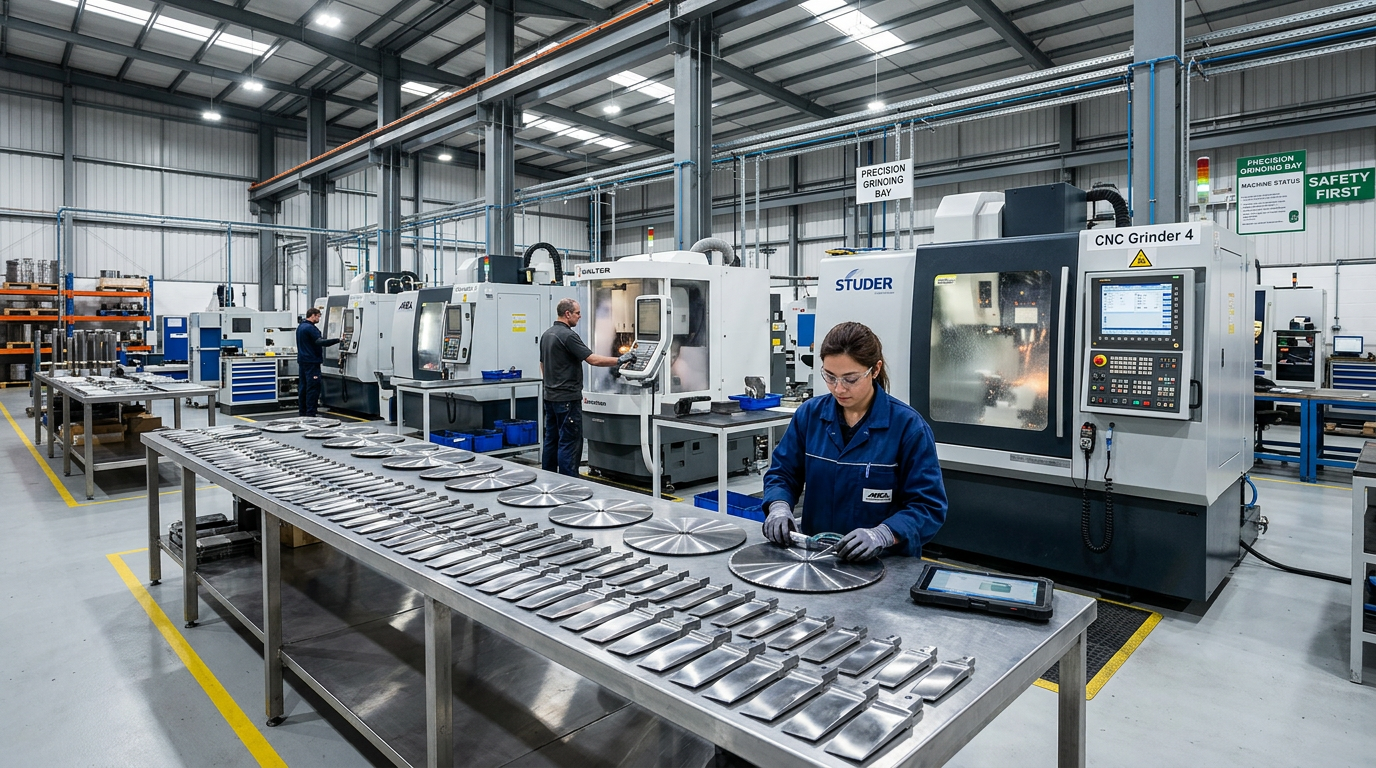
Ask directly: do you perform grinding and heat treatment on-site? Outsourced heat treatment introduces hardness variability — a critical failure point for blades under cyclic load. A qualified factory controls the full process from raw steel to finished edge.
2. Metrology and Inspection Equipment
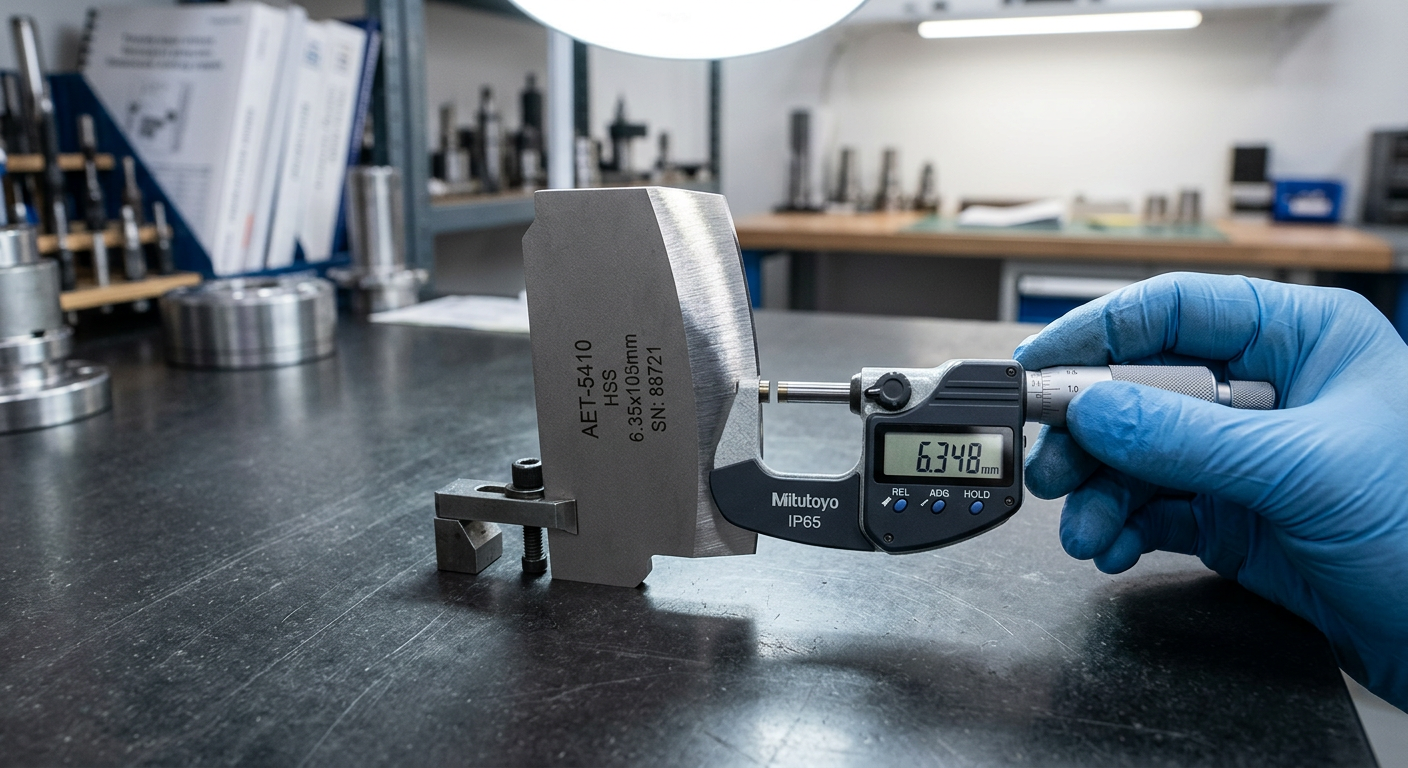
Request a list of QC instruments. Precision blade suppliers operate CMMs (coordinate measuring machines), surface roughness testers, and hardness testers (Rockwell HRC). If a supplier cannot name their inspection equipment, they cannot guarantee tolerances.
3. Material Traceability
Ask for mill certificates on steel or carbide grades. For food-contact applications — such as food-grade cutting blades — material compliance documentation is non-negotiable for regulatory audits.
4. Sample and Prototype Lead Time
A factory with real capacity can produce qualification samples in 7–15 business days. Longer than 4 weeks for a prototype is a red flag that the supplier is outsourcing fabrication.
5. Reference Applications and Product Range
A supplier with proven experience across recycling blades, film slitting blades, and special-shaped profiles demonstrates process versatility — a strong indicator of genuine manufacturing depth rather than a narrow commodity catalog.
How to Structure Your RFQ for Maximum Supplier Accountability
A well-structured Request for Quotation (RFQ) does more than collect prices — it functions as a qualification filter. Suppliers who respond incompletely or substitute materials without explanation are signaling future production problems.
Your RFQ should include:
- 2D drawing or DXF file with all critical dimensions and tolerances called out
- Material specification or request for supplier recommendation with justification
- Required hardness range (e.g., HRC 58–62 for D2 tool steel)
- Surface finish requirement (e.g., Ra 0.4 µm on cutting face)
- Annual volume estimate and initial trial quantity
- Packaging and labeling requirements (especially for OEM integration)
- Request for inspection report format and QC documentation per batch
Ask each supplier to confirm whether they can hold the stated tolerances and to flag any dimension they would recommend modifying for manufacturability. A technically competent factory will engage with your drawing — a reseller will simply quote the price and move on.
For complex geometries, consider requesting a custom industrial blade feasibility review before committing to a full RFQ. This surfaces tooling constraints early and avoids costly revision cycles after samples are cut.
Evaluating Sample Quality: What to Measure Before You Approve Production
Receiving a sample is not the end of qualification — it is the most critical checkpoint. OEM buyers should measure and document every sample against the approved drawing before issuing a production approval.
Dimensional Verification
Use calibrated instruments to verify OD, ID, thickness, and edge angle. For slitting applications — such as rotary slitter knives — thickness variation across the blade face must stay within ±0.005 mm to prevent web wander and edge quality issues at speed.
Hardness Testing
Spot-test hardness at three or more points across the blade. Hardness variation greater than ±2 HRC across a single blade indicates inconsistent heat treatment and predicts premature, uneven wear.
Edge Integrity Under Magnification
Inspect the cutting edge at 10–20x magnification for micro-chipping, grinding burrs, or edge rollover. These defects are invisible to the naked eye but cause immediate quality problems on film, foil, or food substrates.
Real-World Example
A packaging machinery OEM sourcing packaging machine knives for a new horizontal flow-wrap line ran a 500-cycle cut test on qualification samples before approving production. The test revealed edge chipping at cycle 200 on samples from one supplier — a failure mode that would have caused seal contamination in the field. Switching to a supplier with tighter carbide grade control eliminated the issue entirely before any units shipped.
Building a Long-Term Supplier Relationship That Protects Your Supply Chain
Qualifying a supplier once is not enough. OEM blade sourcing requires an ongoing relationship structure that keeps quality consistent across production batches and protects your line from supply disruptions.
Establish these practices from the first production order:
- Approved supplier record — document the qualified supplier, approved material grade, and drawing revision in your internal system
- Batch inspection reports — require a dimensional and hardness report with every shipment, not just the first
- Annual re-qualification — re-sample at least one blade position per year to catch process drift before it reaches your production line
- Safety stock agreement — negotiate a buffer inventory or consignment stock arrangement for high-consumption blade positions to absorb lead time variability
Choosing a direct-factory supplier — rather than a trading company — gives you direct access to the engineering team when specifications change, faster response on urgent replacement orders, and a cleaner chain of custody for material documentation.
If your operation spans multiple cutting applications, consolidating with a supplier capable of covering shredder blades, crusher blades, and precision slitting blades under one roof simplifies qualification management and reduces supplier audit overhead significantly.
Ready to qualify Yishi as your custom blade supplier? Our engineering team responds to RFQs with dimensional feasibility feedback within 24 hours. Submit your drawing and specifications to start the qualification process.


