

Round vs Straight vs Shredder Blades: Choosing the Right Geometry

The right blade geometry is determined by three factors: how the blade moves, what material it cuts, and how fast your line runs. Round blades excel at continuous rotary slitting of films, foils, and food products; straight blades deliver precise linear cuts on sheet materials and packaging substrates; and shredder blades are engineered to fracture and reduce bulky, tough feedstocks like plastic bales, wood pallets, and industrial waste. Choosing the wrong geometry — even with the correct steel grade — leads to premature edge failure, poor cut quality, and unnecessary downtime.
| Criteria | Round Blade | Straight Blade | Shredder Blade |
|---|---|---|---|
| Cut motion | Rotary / rolling | Linear / reciprocating | Rotary shear + tear |
| Best material type | Film, foil, paper, food | Sheet, board, packaging | Bulky waste, plastic, wood |
| Throughput speed | High — continuous | Medium — stroke-limited | High — volume-dependent |
| Edge geometry | Beveled or flat-ground disc | Single or double bevel | Hook-tooth or flat-top profile |
| Typical material grade | D2, HSS, carbide, ceramic | D2, 6CrW2Si, carbide | D2, H13, Mn steel, carbide |
| Regrindable | ✓ Multiple cycles | ✓ Multiple cycles | ✓ Limited by tooth profile |
| Custom geometry | ✓ Diameter, bore, bevel | ✓ Length, angle, profile | ✓ Hook angle, tooth pitch |
| Typical industries | Slitting, food, packaging | Packaging, paper, metal | Recycling, shredding, waste |
Round Blades: Continuous Rotary Cutting for High-Speed Lines
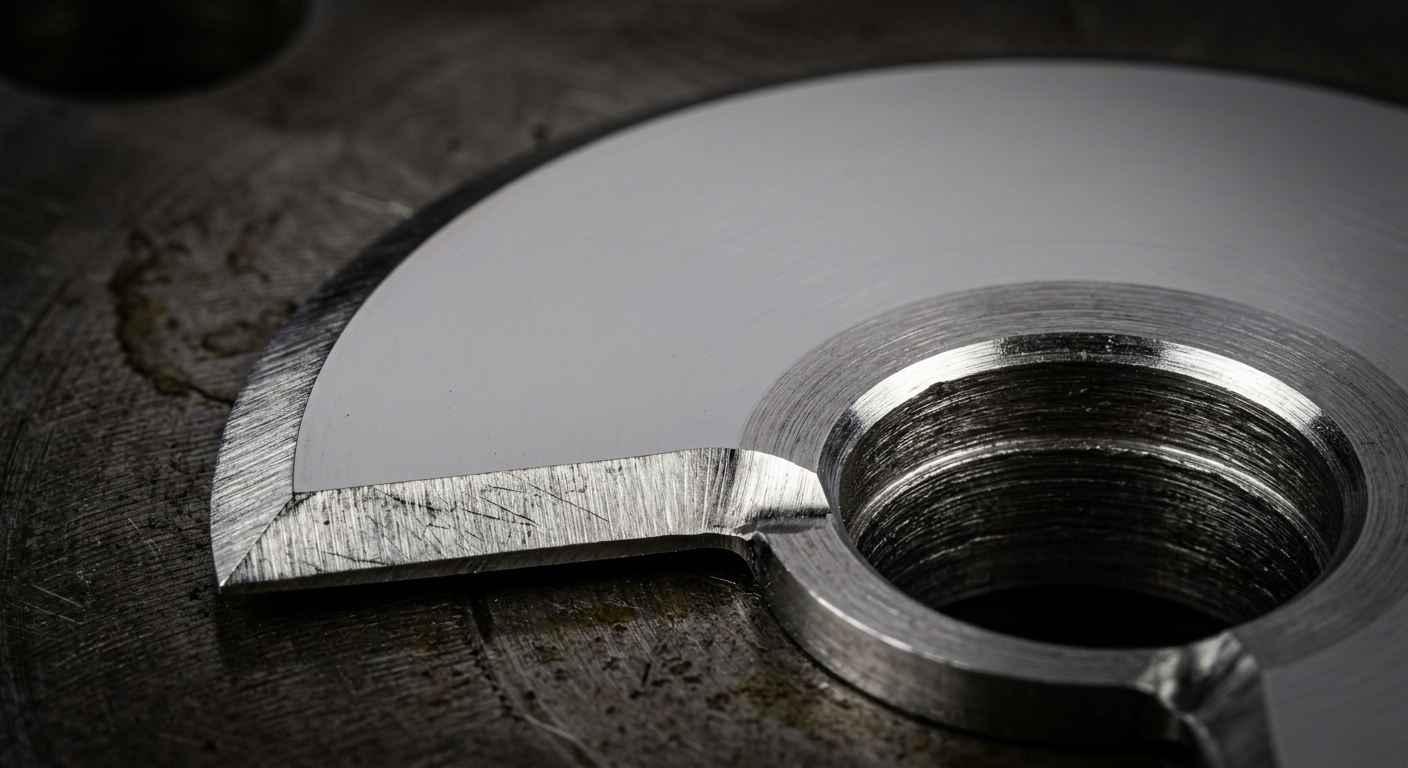
Round blades — also called circular knives or disc blades — rotate against a fixed or counter-rotating surface to produce a continuous shearing action. Because the cutting edge is distributed around the full circumference, wear is spread evenly and service intervals are significantly longer than with linear blades running the same material.
Where Round Blades Perform Best
- Film and foil slitting: Thin polymer films, aluminum foil, and laminated packaging webs require razor-sharp, burr-free edges that only a precision-ground disc blade can deliver consistently at speeds above 300 m/min.
- Food portioning: Circular bread cutting blades in stainless or food-grade tool steel slice bread loaves, cheese blocks, and processed meat with minimal product drag.
- Paper and nonwoven slitting: Matched pairs of upper and lower disc blades create clean slit edges on tissue, kraft, and nonwoven rolls without fiber tear-out.
For example, a flexible packaging converter running BOPP film at 400 m/min would specify a tungsten carbide-tipped round blade with a 0.3 mm side clearance and a 20° bevel to maintain edge sharpness across multi-shift production without mid-shift blade changes.
Diameter, bore tolerance, side runout, and bevel angle are the four critical dimensions — all of which Yishi holds to ±0.01 mm on precision-ground disc blades. See our industrial blades for plastic converting and recycling for slitting-specific configurations.
Straight Blades: Linear Precision for Sheet and Packaging Cuts
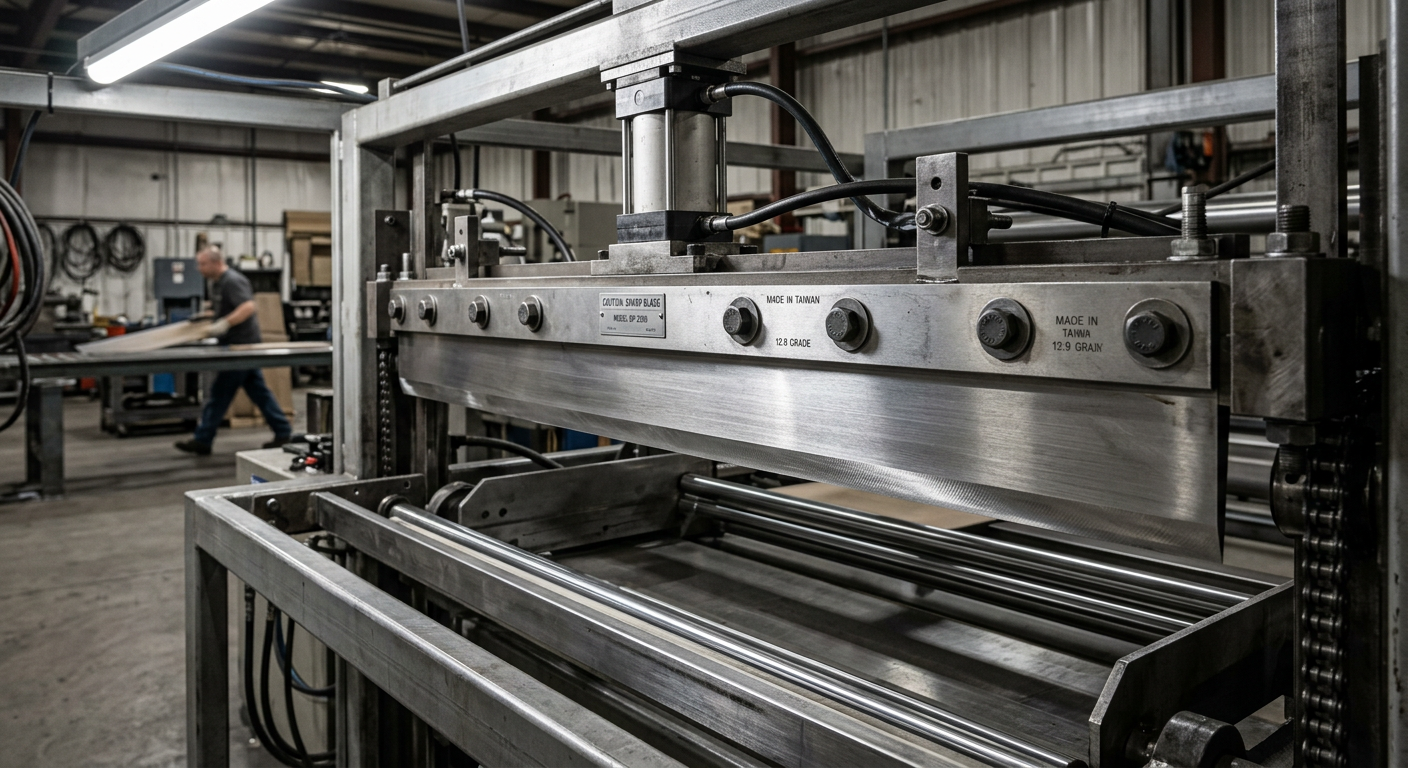
Straight blades — including guillotine knives, reciprocating blades, and long shear knives — move in a linear path to cut across a material in a single stroke or continuous reciprocating motion. Their geometry makes them the default choice wherever a defined cut length, clean cross-cut, or precise sheet separation is required.
Key Application Categories
- Packaging machinery: Reciprocating straight blades on form-fill-seal machines cut through multi-layer laminates, heat-sealed pouches, and shrink film at up to 120 cuts per minute. Our packaging machine knives are ground to match OEM tolerances for drop-in replacement.
- Paper and board cutting: Guillotine blades on sheeting lines handle corrugated, kraft, and coated board up to 8 mm thick. Edge angle typically ranges from 23° to 30° depending on board density.
- Metal shearing: Long straight shear blades on coil slitting lines cut cold-rolled steel and aluminum sheet with clearances as tight as 5–8% of material thickness to minimize burr height.
Straight blade performance is highly sensitive to edge angle selection. A blade ground at 25° for paperboard will chip rapidly on stainless steel sheet — a common and costly specification error.
Shredder Blades: High-Torque Fracture Cutting for Bulk Reduction
Shredder blades operate on a fundamentally different principle: rather than slicing cleanly through material, they grip, tear, and fracture feedstock between counter-rotating shafts. Hook-tooth profiles pull material into the cutting zone; flat-top profiles shear it against a fixed counter-knife. The result is aggressive size reduction rather than dimensional precision.
Geometry Determines Output Particle Size
- Hook angle: Aggressive hook angles (30°–45°) increase material pull-in and throughput but produce coarser output. Shallower hooks (15°–20°) yield finer, more uniform particle sizes.
- Tooth pitch: Closer tooth spacing reduces output particle size and is preferred for plastic film bales and e-waste. Wider pitch handles thick-walled HDPE drums and timber pallets.
- Stack height and spacers: Shredder rotors are built up from individual blade discs and spacers — adjusting spacer width changes output strip width without replacing the blades themselves.
A municipal solid waste operator processing mixed plastic bales, for instance, might run D2 tool steel shredder blades with a 35° hook angle and 40 mm tooth pitch for high-volume throughput, then switch to H13 hot-work steel blades with a tighter 25 mm pitch when processing rigid HDPE containers that require a cleaner, more uniform flake for downstream washing lines.
For operations focused on plastic-specific size reduction, granulator blades and crusher blades offer complementary geometries optimized for secondary and tertiary reduction stages.
Side-by-Side Comparison: Which Geometry Fits Your Operation?
The table below consolidates the key selection criteria across all three blade geometries. Use it as a first-pass filter before specifying material grade, edge angle, or dimensional tolerances.
| Criteria | Round Blade | Straight Blade | Shredder Blade |
|---|---|---|---|
| Cut motion | Rotary / rolling | Linear / reciprocating | Rotary shear + tear |
| Best material type | Film, foil, paper, food | Sheet, board, packaging | Bulky waste, plastic, wood |
| Throughput speed | High — continuous | Medium — stroke-limited | High — volume-dependent |
| Edge geometry | Beveled or flat-ground disc | Single or double bevel | Hook-tooth or flat-top profile |
| Typical material grade | D2, HSS, carbide, ceramic | D2, 6CrW2Si, carbide | D2, H13, Mn steel, carbide |
| Regrindable | ✓ Multiple cycles | ✓ Multiple cycles | ✓ Limited by tooth profile |
| Custom geometry | ✓ Diameter, bore, bevel | ✓ Length, angle, profile | ✓ Hook angle, tooth pitch |
| Typical industries | Slitting, food, packaging | Packaging, paper, metal | Recycling, shredding, waste |
If your application spans more than one geometry — for example, a recycling line that pre-shreds bales and then granulates the output — you will need matched blade sets for each stage. Yishi supplies complete blade packages across all three geometry types from a single factory source, simplifying qualification and lead time management.
Selecting the Right Geometry: A Practical Decision Framework
Before contacting a blade supplier, answer these four questions to narrow your specification:
- 1. What is the blade's motion? Rotary → round blade. Linear stroke → straight blade. Counter-rotating shaft → shredder blade.
- 2. What is the material and its thickness? Thin flexible webs favor disc blades. Rigid sheet and board favor straight blades. Bulky or irregular feedstock requires shredder geometry.
- 3. What is the required output quality? Dimensional precision and clean edges → round or straight. Particle size reduction without edge quality requirements → shredder.
- 4. What is the duty cycle and resharpening budget? High-speed continuous lines benefit from carbide-tipped round blades with long regrind intervals. Lower-speed packaging lines can run D2 straight blades resharpened in-house.
Once geometry is confirmed, material grade and edge angle become the next decision layer — a topic covered in detail in our guide on extending industrial blade service life. For non-standard profiles — serrated edges, compound bevels, or asymmetric cross-sections — Yishi's custom industrial blades team can engineer and prototype to your drawing or sample within standard lead times.
Ready to match a blade geometry to your specific machine and material? Contact Yishi's application engineers with your cut material, machine type, and current blade spec — we'll return a matched recommendation with a fast quote.


