

Custom Food Processing Blades: What Your Blade Supplier Needs to Know Before Quoting

If you want an accurate, fast quote on a custom food processing blade, your supplier needs five things: the exact product being cut, the machine and cutting motion, the blade geometry and tolerances, the material and hygiene requirements, and your expected service life. Hand over a drawing alone and you’ll get a price — but probably not the right blade. Hand over the full picture and a good factory will quote in 48 hours and ship a blade that actually lasts.
Start with the product being cut, not the blade
Most buyers send a drawing first. That’s backwards. The single biggest driver of blade design is what you’re cutting — frozen tuna loins behave nothing like fresh dough, and a blade optimized for one will fail on the other within a shift.
Tell your supplier:
- Product type — meat, cheese, bread, vegetables, frozen blocks, confectionery, etc.
- State — fresh, chilled (0–4°C), frozen (-18°C and below), tempered, or par-baked.
- Hardness and fibrousness — boneless chicken breast vs. bone-in pork ribs is a completely different blade.
- Sticky or abrasive — caramel and cheese cling; bread crusts and breaded nuggets sandblast a cutting edge.
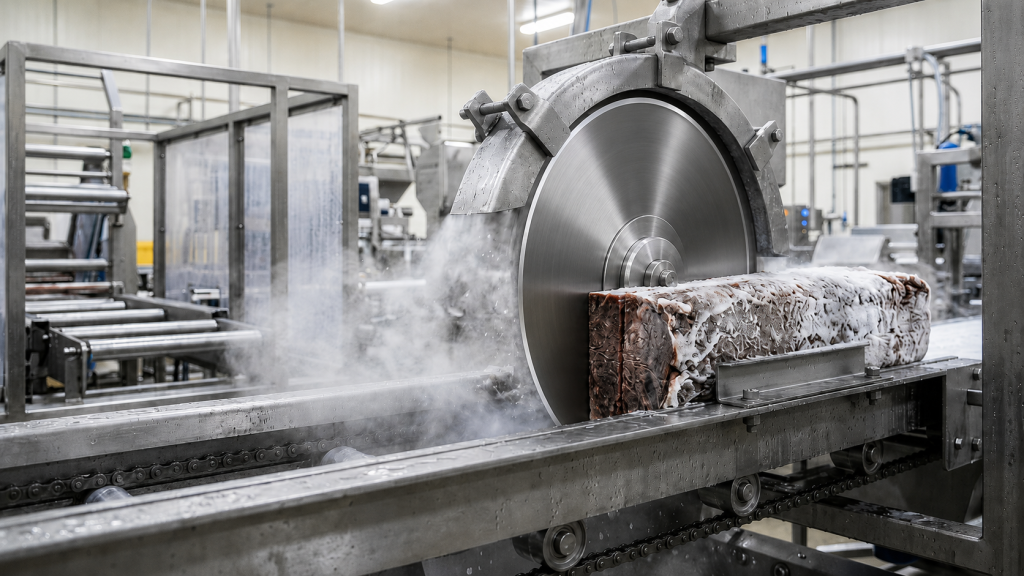
For instance, a frozen seafood processor we worked with kept burning through standard 420 stainless circular blades every two weeks. The reason was simple: they were portioning -25°C tuna, but had spec’d a blade designed for chilled fish. Switching to a higher-carbon martensitic stainless with a thicker edge geometry tripled the service life — no machine changes required.
Describe the machine and the cutting motion
A blade is half of a cutting system. The other half — the machine — dictates geometry, balance tolerance, and edge angle.
What your supplier needs
- Machine make and model if possible (a Marel I-Cut, a Grasselli NSL, a Bizerba slicer — each has known blade interfaces).
- Cutting motion — rotary, reciprocating, guillotine, ultrasonic, or band.
- RPM or strokes per minute at production speed.
- Direction of cut relative to product feed.
- Mounting details — bore diameter, keyway, bolt pattern, drive pin locations.
RPM matters more than people think. A blade running at 3,000 RPM has very different balance requirements than one at 800 RPM. Skip this detail and you risk vibration, premature bearing wear, and chipped edges that look like a material defect but aren’t.
Geometry: the numbers that actually change the quote
Here’s where a vague RFQ becomes expensive. Saying “200mm circular blade” could mean 50 different blades. The dimensions that drive cost and performance:
- Outer diameter — to ±0.05mm if precision-fit.
- Bore diameter and tolerance — H7 fit is standard but specify.
- Thickness — even 0.2mm of extra thickness changes blanking, grinding time, and steel cost.
- Edge profile — single bevel, double bevel, hollow ground, scalloped, serrated, or smooth.
- Edge angle — 17° for soft products, 22–28° for tougher protein, 30°+ for frozen.
- Surface finish — Ra value on the cutting face affects release and hygiene.
- Flatness and runout — typically 0.02–0.05mm TIR for high-speed rotary.
If you’re unsure about edge angle, send a sample of your current blade. A good supplier will reverse-engineer it and propose improvements. Our food processing blade engineering team does this routinely — sometimes the original geometry is fine, sometimes the customer has been living with a 10-year-old compromise.
Material choice is a conversation, not a checkbox
Food blade material isn’t just “stainless steel.” The grade decides corrosion resistance, edge retention, sharpenability, and FDA/EU food contact compliance. The common options:
- 420 / 420J2 — economical, good corrosion resistance, moderate edge life. Fine for soft products and wet environments.
- 440A / 440C — harder, holds an edge longer, slightly less corrosion-resistant. Good for protein and cheese.
- 1.4116 (X50CrMoV15) — German tool steel, balanced toughness and edge retention. Industry favorite for high-end slicing.
- D2 / SKD11 — excellent wear life, but lower corrosion resistance. Best for dry, abrasive products.
- Powder metallurgy steels (e.g. CPM) — premium edge life for high-volume lines where blade changes are costly.
Tell your supplier about washdown chemicals too. Chlorinated sanitizers eat 420 stainless faster than people expect. If your CIP cycle uses 200ppm chlorine at 60°C twice a day, you may need to step up the grade or specify passivation. For a deeper material comparison, see how to choose the right industrial blade material.
Hygiene, certification, and food contact compliance
This section gets skipped on RFQs more often than any other — and it’s the one that can disqualify a blade after it’s already made.
- Food contact standards — FDA 21 CFR 177, EU 1935/2004, EU 10/2011 for plastics in handles, China GB 4806.
- Coating restrictions — some clients prohibit any non-stick coating; others require it. Specify.
- Surface finish — for direct food contact, Ra ≤ 0.8 μm is common to prevent bacterial harborage.
- Welding and joints — must be continuous, polished, no crevices.
- Traceability — do you need material certificates (3.1 mill certs) with each batch?
A bakery customer producing pre-sliced sandwich bread once rejected an entire shipment because the supplier hadn’t documented the steel’s compliance with EU 1935/2004 — the blades worked perfectly, but the QA file was incomplete. Two weeks of production loss over a piece of paper. Specify documentation upfront.
Volume, frequency, and the case for prototyping
Quantity changes everything — pricing, lead time, even which factory will take the job seriously.
Be honest about your real numbers
- Trial / sample quantity — usually 1–10 pieces.
- First production order — typical MOQ ranges.
- Annual estimated usage — drives tooling investment decisions.
- Reorder cadence — monthly, quarterly, or as-needed.
If you’re running a new product line, ask for a trial order of 2–5 blades before committing to volume. A reputable factory will encourage this. At Yishi we’d rather make five samples, validate them on your line, and earn a five-year repeat order than push 200 pieces of an unproven design out the door.
Also — tell your supplier if you expect repeat orders. It changes how the tooling is built. A one-off blade might use general-purpose fixtures; a recurring SKU justifies dedicated tooling that improves consistency between batches.
Service life expectations: define “long lasting”
“We want a blade that lasts longer” is the most common — and least useful — line in an RFQ. Longer than what? Lasts how?
Quantify it:
- Current blade service life — in shifts, hours, kg of product cut, or number of cuts.
- Failure mode — does the blade wear flat, chip, deform, corrode, or break?
- Sharpening interval — and whether the blade is sharpened on-machine or removed.
- Acceptable end-of-life criteria — when do operators decide to swap it?
A meat processor cutting 8 tons per shift with a blade change every 40 hours has a clear baseline. A supplier can then quote a blade targeting 60 or 80 hours — and you can hold them accountable. Without that baseline, you’re comparing apples to opinions.
Once you have a baseline, smart sharpening and storage can stretch life further. Our guide on extending industrial blade service life goes deep on this.
Packaging, shipping, and the details that bite later
The blade is made. Now it has to arrive on your dock undamaged, identifiable, and ready to use. Don’t leave this to the supplier’s default.
- Edge protection — VCI paper, edge guards, foam inserts, or individual sleeves for sharp blades.
- Rust prevention — oil coating, VCI bag, or dry seal for ocean freight (typically 30–45 days in transit).
- Labeling — part number, batch, heat treatment record, date of manufacture.
- Incoterms — FOB, CIF, DAP, DDP. Each changes who handles customs and damage liability.
- Documentation — commercial invoice, packing list, material certs, certificate of origin, food contact compliance declaration.
Export packaging is one of those quiet quality signals. A factory that packs blades carelessly in loose cartons probably machines them carelessly too.
A complete RFQ checklist you can send tomorrow
Copy this into your next email to a blade supplier and you’ll get a serious quote within 72 hours instead of a week of back-and-forth questions.
- Product cut, state (fresh/frozen), and rough hardness
- Machine make, model, and cutting motion
- RPM or strokes per minute, blade mounting details
- Drawing or sample with all critical dimensions and tolerances
- Preferred material grade or current material in use
- Edge geometry and surface finish requirements
- Hygiene / food contact certifications needed
- Washdown chemistry and frequency
- Current blade service life and failure mode
- Trial quantity and annual volume estimate
- Target lead time and shipping terms
- Required documentation
Send this, and any competent factory can quote intelligently. Send half of it, and you’ll get half a quote.
Working with Yishi on a custom food blade
The factories that quote fastest aren’t cutting corners — they just ask the right questions upfront. The ones that quote slowly are usually trying to guess at missing information, or worse, will quote anyway and figure it out in production. Neither is good for you.
At Yishi Machinery we engineer custom food processing blades from a 3,000 m² facility with in-house CNC grinding, heat treatment, and hardness control — backed by 1,000+ invention patents and eight years of food-blade work for processors across Europe, North America, and Southeast Asia. We’re happy to start with a trial order of one to five pieces, validate it on your line, then scale to volume with the same tooling and the same operators.
If you have a drawing, a sample, or just a tricky cutting problem you can’t solve with off-the-shelf blades, send us the details and we’ll come back with a real quote and a real recommendation. You can also browse our full food processing blade range or related packaging blade solutions if you’re spec’ing multiple stations on the same line.


