
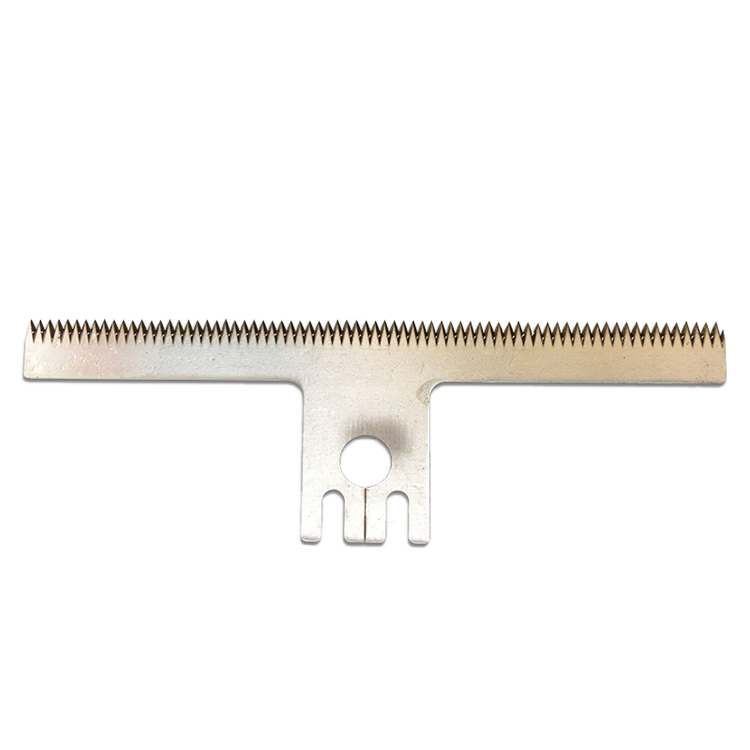
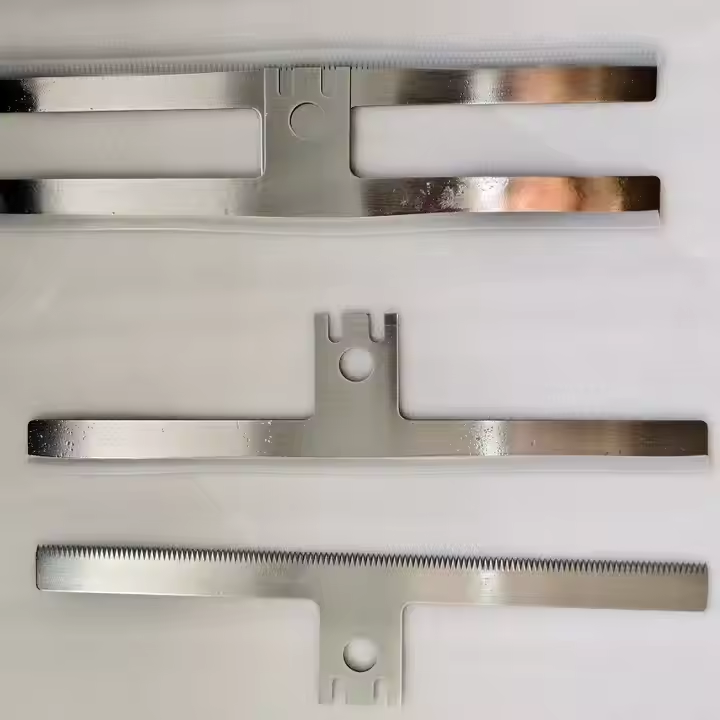
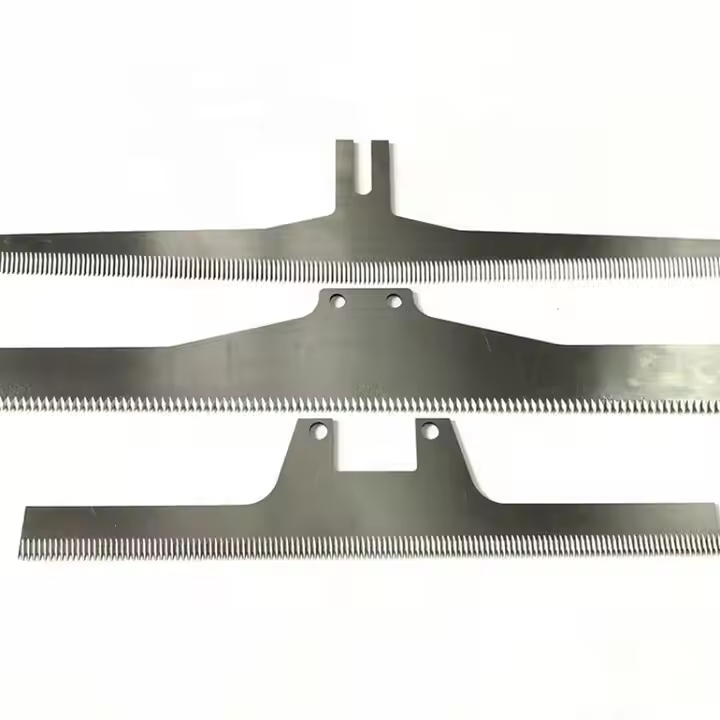
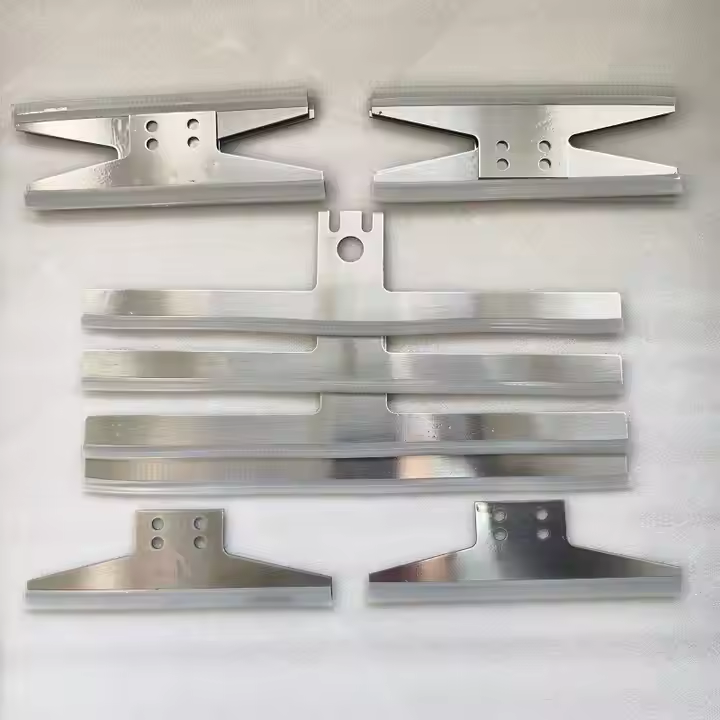
Installed as the stationary or moving knife in VFFS and HFFS bagging machines, cutting polyethylene, polypropylene, and laminated films. The T-shape blade provides the stiffness needed for clean cuts through gusseted or thick-gauge materials.
Customized sizes are available, according to your drawing or sample.
YISHI T-shape blades are engineered for stable, high-precision cutting in automated packaging and converting lines. The T-shaped cross-section provides inherent rigidity, resisting deflection under load to maintain a consistent cut line. These blades are specified by maintenance teams and OEMs for form-fill-seal (FFS) machines, pouch-making equipment, and horizontal/vertical wrappers. Manufactured from tool steels such as D2 (Cr12MoV), M2 high-speed steel, or SKD11, each blade undergoes vacuum heat treatment to achieve a uniform hardness of HRC 58–62. The result is a cutting edge that balances wear resistance with toughness, reducing unplanned downtime in high-cycle applications.
The T-shaped cross-section increases the section modulus, minimizing lateral deflection during the cutting stroke. This geometry is critical for maintaining cut quality on thin films and multi-layer laminates.
Blades are heat-treated in a vacuum furnace to HRC 58–62, depending on the steel grade. This process ensures a uniform hardness distribution and minimal distortion, preserving the blade's flatness and edge integrity.
Standard grades include D2 (Cr12MoV) for general wear resistance, M2 HSS for higher-temperature cutting zones, and SKD11 for enhanced toughness. Tungsten carbide inserts are available for abrasive media.
The cutting edge is ground to a surface finish of Ra 0.4 µm or finer. This low-friction edge reduces adhesive buildup from packaging films and extends the interval between blade changes.
Blades are manufactured to customer drawings or OEM part numbers. Typical overall lengths range from 50 mm to 600 mm, with thicknesses from 2 mm to 12 mm. Bolt-hole patterns and slot dimensions are machined to order.
| Dimensions | Overall length: 50–600 mm; width: 20–80 mm; thickness: 2–12 mm. Custom dimensions per drawing. |
| Materials | D2 (Cr12MoV), M2 HSS, SKD11, H13, tungsten carbide (inserts) |
| Hardness | HRC 58–62 for tool steels; up to 89 HRA for carbide |
| Tolerances | Dimensional tolerance ±0.02 mm on critical features; flatness within 0.05 mm over 100 mm |
| Surface Finish | Cutting edge ground to Ra ≤ 0.4 µm; body surface Ra 0.8 µm or as specified |
| Customisation | Manufactured to customer drawings, samples, or OEM part numbers. Specify material, hardness, edge angle, and mounting hole configuration. |
YISHI manufactures T-shape blades in-house, from material sourcing through final inspection. We use vacuum heat treatment furnaces with controlled quenching to achieve consistent HRC values across the entire batch. Every blade is inspected for hardness, dimensional accuracy, and edge condition before shipment. We accept orders for single prototypes and full production volumes, with no minimum order quantity on custom designs. Lead times are based on the actual production schedule, not inflated estimates. Our engineering team reviews each drawing for manufacturability and will propose alternative steel grades if a different material would improve blade life in your specific application.
D2 (Cr12MoV) at HRC 58–60 is the standard choice for low-density polyethylene and most general packaging films. It provides an effective balance of edge retention and corrosion resistance. For abrasive or filled films, M2 HSS or a carbide-edged blade may be more suitable.
Yes. We manufacture blades to your drawing or a sample of your current blade. Provide the hole diameters, center distances, and any counterbore or countersink specifications. We will replicate the pattern exactly.
Lead times depend on the complexity, material, and current production queue. A typical custom order ships within 15–25 working days after drawing approval. We provide a confirmed delivery date with every quotation.
We focus on manufacturing new blades to the original specifications. Re-sharpening is not a standard service we offer, as the T-shape geometry often requires precise fixture grinding to maintain the original cut height and angle.
For laminates containing aluminum foil, we typically recommend M2 HSS or SKD11 at HRC 60–62. The higher hardness resists the accelerated edge rounding caused by the abrasive foil layer. Carbide inserts are an option for extremely high-volume runs.