
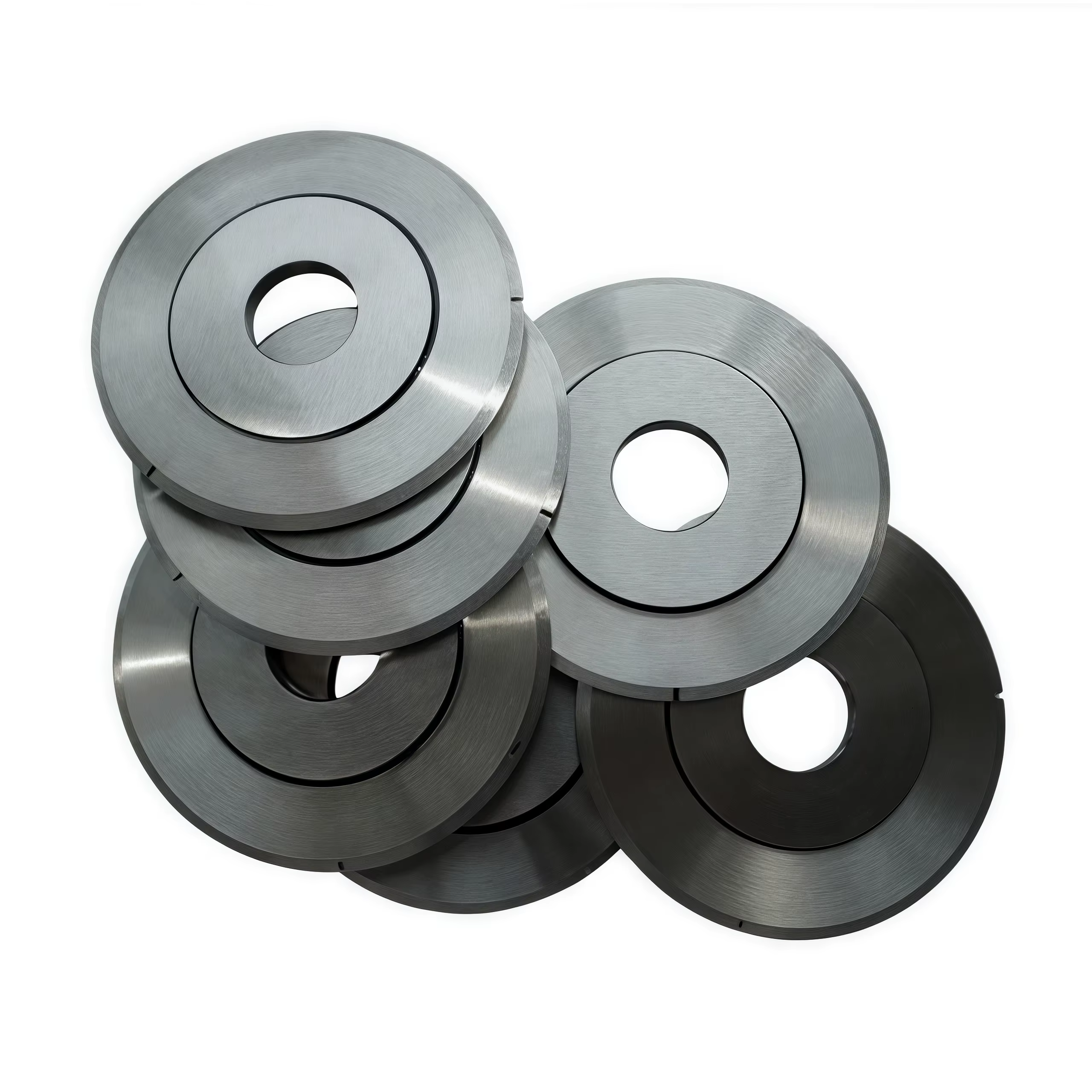
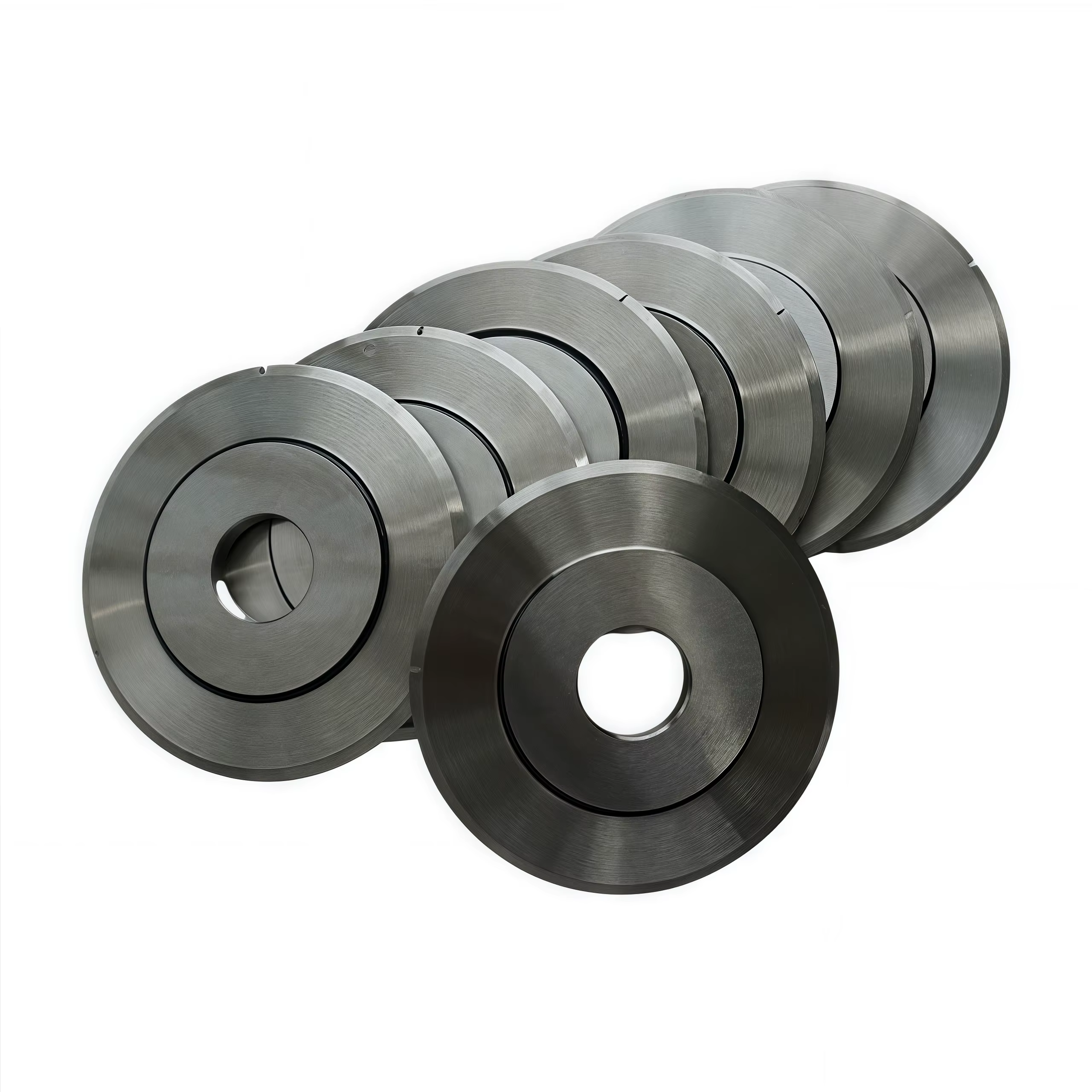
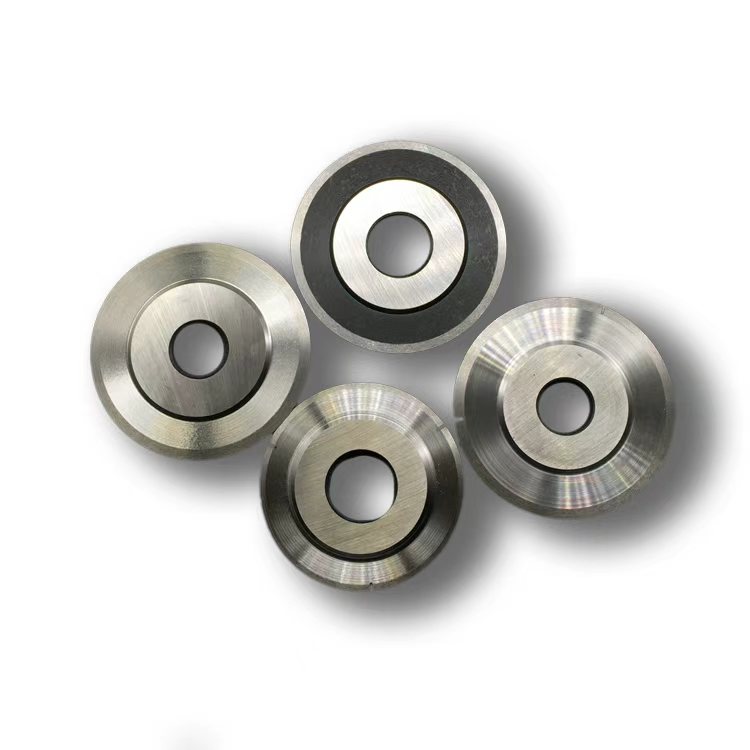
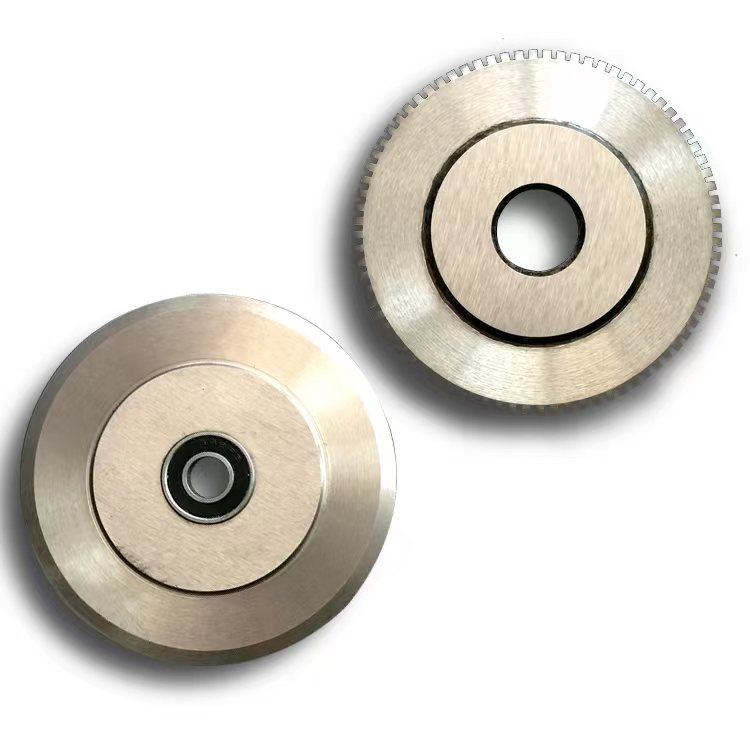
Slitting of BOPP, PET, PE, and laminated films on slitter rewinders. D2 or M2 blades are paired with pneumatic holders for clean edge trim and centre slitting.
Customized sizes are available, according to your drawing or sample.
The pneumatic slitting knife is a pneumatically actuated circular cutting tool designed for high-speed slitting of flexible web materials in automated processing lines. It is specified by converting engineers, maintenance supervisors, and OEM integrators for slitter rewinders, packaging machines, and printing presses. The knife assembly uses compressed air to control blade engagement, delivering consistent cut quality and reducing mechanical wear. Typical material grades include D2 (Cr12MoV) hardened to HRC 58–60, M2 high-speed steel at HRC 62–65, and tungsten carbide for abrasive media. Standard outer diameters range from 70 mm to 800 mm, with bore sizes and edge profiles machined to customer specifications.
Pneumatic actuation provides uniform cutting pressure across the blade edge, minimising deflection and ensuring clean, burr-free slits at line speeds up to 500 m/min.
Blades are produced from D2, SKD11, M2, or 9CrSi tool steels, vacuum heat-treated to HRC 58–65 for a balance of edge retention and impact resistance.
For slitting abrasive films, glass-fibre-reinforced tapes, or metal foils, solid tungsten carbide grades with sub-micron grain structure achieve hardness above HRA 89.
Bore tolerances are held to H7, with face runout and bore concentricity within 0.005 mm, ensuring stable mounting on pneumatic knife holders.
Single-bevel, double-bevel, and radiused edges are CNC-ground to match specific slitting geometries, including shear-cut and crush-cut configurations.
|
OD(MM)
|
ID(MM)
|
Inside thickness(MM)
|
External thickness(MM)
|
Marerial
|
|
70
|
24
|
5
|
2.5
|
HSS/SKD11/9CRSI
|
|
76
|
19
|
5
|
3
|
HSS/SKD11/9CRSI
|
|
76
|
17
|
5
|
3
|
HSS/SKD11/9CRSI
|
|
76
|
22
|
6
|
3
|
HSS/SKD11/9CRSI
|
|
80
|
22
|
6
|
3
|
HSS/SKD11/9CRSI
|
|
CUSTOM
|
CUSTOM
|
CUSTOM
|
CUSTOM
|
CUSTOM
|
| Dimensions | OD 70–800 mm, ID 15–150 mm, thickness 0.5–8.0 mm. Custom sizes machined from drawing or sample. |
| Materials | D2 (Cr12MoV), SKD11, M2, 9CrSi, HSS, tungsten carbide (YG8, YG10X, YG15) |
| Hardness | HRC 58–65 for tool steels; HRA 89–93 for tungsten carbide |
| Tolerances | OD ±0.02 mm, ID H7, thickness ±0.005 mm, parallelism 0.002 mm, runout 0.005 mm |
| Surface Finish | Ra 0.2–0.4 µm on cutting faces; mirror finish available on request |
| Customisation | Blade OD, ID, thickness, edge angle, bevel type, and coating (TiN, TiCN, CrN) can be specified. OEM part number cross-referencing supported. |
YISHI Machinery manufactures pneumatic slitting knives in a dedicated tooling facility with in-house vacuum heat treatment and multi-axis CNC grinding. Material traceability is maintained from mill certificate to finished blade, with every batch tested for hardness and dimensional conformity. We stock standard D2 and M2 blanks for expedited delivery and accept custom profiles with a typical lead time of 7–15 working days. Our engineering team reviews each drawing for manufacturability and can recommend material upgrades or geometry adjustments to extend blade life in your specific application. No minimum order quantity applies for prototype and trial orders.
D2 (Cr12MoV) pneumatic slitting knives are typically vacuum heat-treated to HRC 58–60. This range provides high wear resistance while maintaining sufficient toughness to withstand the mechanical shock of pneumatic engagement. For applications requiring higher hardness, M2 high-speed steel at HRC 62–65 or tungsten carbide may be recommended.
Yes. Most tool steel pneumatic slitting knives can be reground multiple times, provided the minimum usable diameter is not exceeded. YISHI can provide regrinding services or supply new blades to the original specification. Tungsten carbide knives are typically replaced rather than reground due to their hardness.
We require the outer diameter, inner diameter, thickness, edge angle, and material preference. A dimensional drawing or CAD file is preferred. If replacing an existing knife, the OEM part number and machine model help us cross-reference the correct geometry and tolerances.
Yes. Physical vapour deposition (PVD) coatings such as TiN, TiCN, and CrN can be applied to tool steel knives to reduce friction and improve wear resistance. Coating selection depends on the substrate material and the film being slit. Our engineers can advise on the most suitable coating for your process.
Standard D2 and M2 blanks can be machined and shipped within 7–10 working days. Custom sizes requiring forging or special material procurement typically ship within 15 working days. Expedited production is available for urgent requirements.