
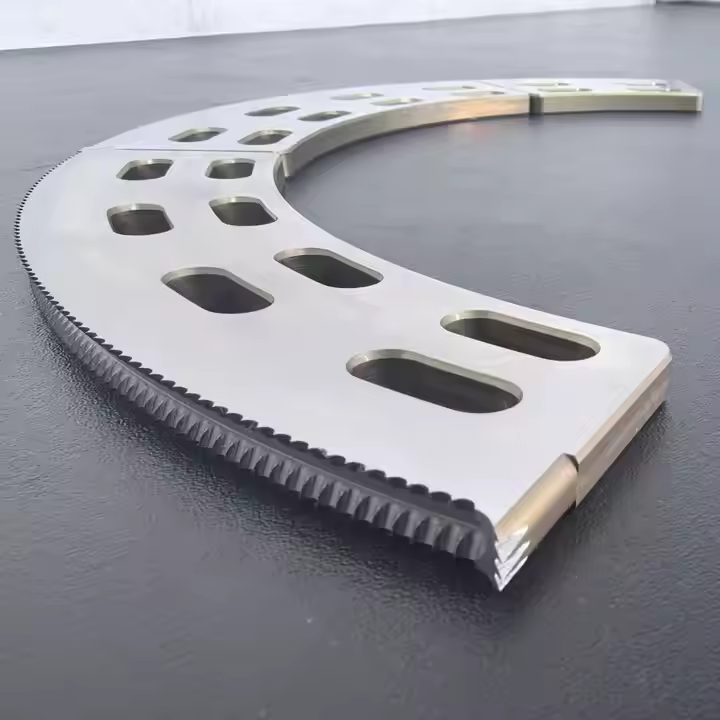
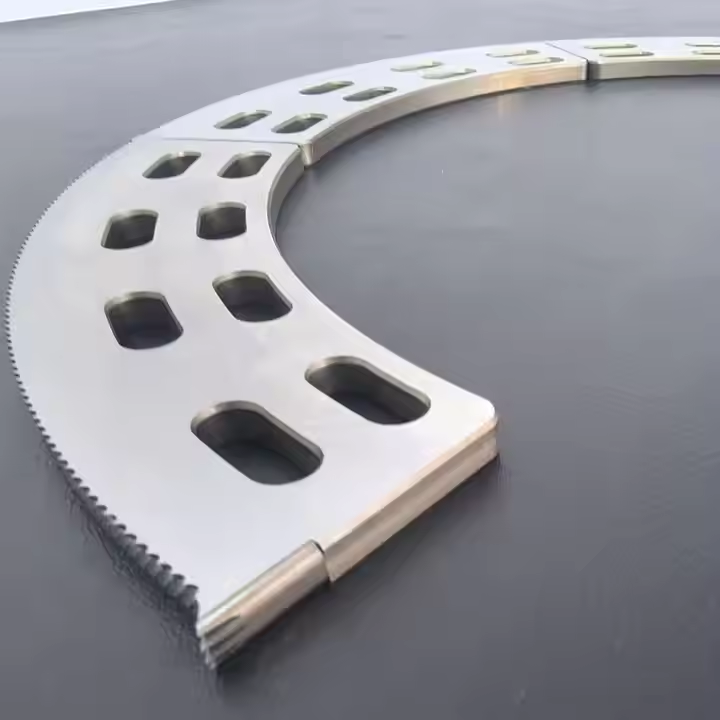
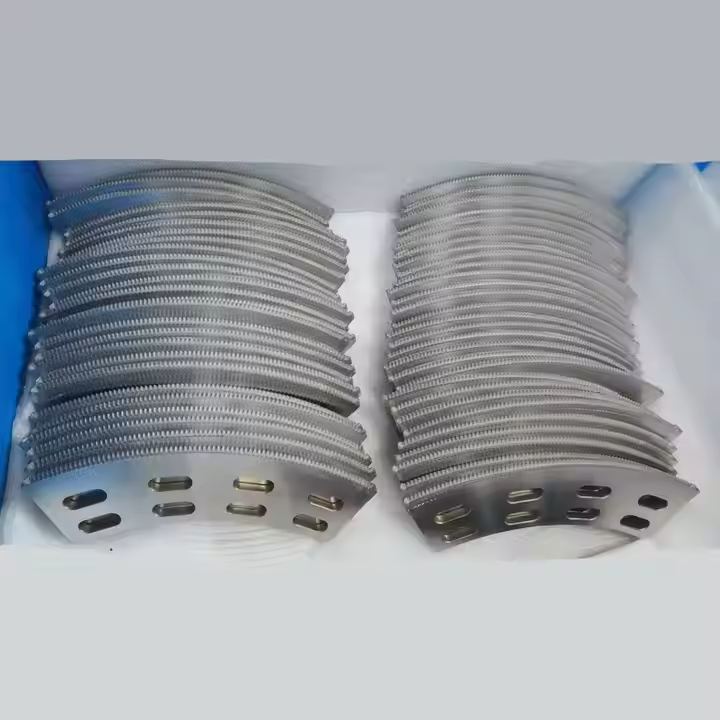
Installed on flexo printer slotter rotary heads to cut slots in single-wall and double-wall corrugated board at line speeds up to 250 sheets per minute.
Customized sizes are available, according to your drawing or sample.
Slotter blades for cardboard box printer slotter machines are precision cutting tools designed to produce clean, burr-free slots in corrugated board, solid board, and similar packaging materials. These blades are installed on rotary slotting heads of flexo printer slotters, rotary die cutters, and inline converting lines from OEMs such as BOBST, Dongfang, or LiShen. Manufactured from vacuum heat-treated tool steels with hardness ratings from HRC 56 to HRC 62, the blades maintain edge integrity over extended production runs. Dimensional flatness is held to ±0.01 mm to minimise vibration and ensure consistent slot depth across the full web width. Procurement engineers and maintenance supervisors specify these blades to reduce unplanned downtime and maintain box quality on high-speed corrugated converting lines.
Blades are available in D2 (HRC 60–62), M2 high-speed steel (HRC 62), and SKD-11 (HRC 60–61). Vacuum heat treatment ensures uniform hardness distribution and minimises distortion.
Surface flatness is controlled to ±0.01 mm, reducing lateral runout and ensuring consistent slot depth across the blade length, which is critical for high-speed rotary slotting.
Blades are manufactured to customer-supplied drawings or OEM part numbers. Typical thickness ranges from 1.5 mm to 6.0 mm, with outer diameters and bore patterns matched to specific slotting head designs.
Single-bevel, double-bevel, and serrated edge geometries are ground to order. Edge angles are specified based on board grade—typically 20° to 30° for single-wall corrugated, steeper for double-wall.
Optional TiN or CrN PVD coatings can be applied to extend service intervals when processing abrasive or recycled-content board. Coating thickness is typically 2–4 µm.
|
Product name
|
Knife Slotter Blades for Cardboard Box Printer Slotter Machine
|
|
Scope of application
|
Paper/film/tape/plastic/paper tube/food/metallurgy/clothes
|
|
Material
|
9Crsi/SKD-11/D2/HSS/M2/440B/420J
|
|
Hardness (HRC)
|
56/60/61/60/62/58/58
|
|
Precision (Fatness)
|
±0.01
|
|
Package
|
Plastic Bag+Foam+Carton Box
|
| Dimensions | Outer diameter: 150–400 mm (typical); inner bore: 20–80 mm (matched to arbor); thickness: 1.5–6.0 mm; slot width and depth per drawing |
| Materials | 9CrSi, SKD-11, D2, M2, HSS, 440B, 420J2 |
| Hardness | HRC 56–62 (material-dependent) |
| Tolerances | Flatness ±0.01 mm; thickness tolerance ±0.02 mm; bore tolerance H7 |
| Surface Finish | Ground finish, Ra ≤0.4 µm on bevel faces; optional PVD coating |
| Customisation | Manufactured to customer drawing, sample blade, or OEM part number. Bore pattern, keyway, bolt hole circle, edge angle, and coating all specifiable. |
YISHI Machinery manufactures slotter blades in-house using CNC grinding centres and vacuum heat treatment furnaces, giving direct control over hardness profiles and dimensional accuracy. Every blade batch is inspected for flatness and hardness before shipment, with inspection reports available on request. We accept single-piece prototype orders and full production quantities with consistent lead times. Our engineering team reviews each drawing for manufacturability and can recommend steel grade and edge geometry based on your board type and machine speed. No minimum order quantity on custom sizes.
For double-wall and heavy-duty corrugated, D2 (HRC 60–62) or M2 high-speed steel (HRC 62) is recommended. D2 offers a good balance of wear resistance and toughness. M2 provides higher hot hardness for high-speed lines where frictional heating is significant. Our engineers can advise based on your specific board grade and machine parameters.
Yes. Provide the OEM part number or a dimensional drawing, and we will manufacture to match. If you do not have a drawing, send a sample blade and we will reverse-engineer the critical dimensions including OD, bore, bolt hole circle, thickness, and bevel angle.
Standard flatness is held to ±0.01 mm across the blade body. Tighter tolerances can be quoted for applications requiring exceptionally low runout. Each blade is checked on a surface plate during final inspection.
Yes, TiN (titanium nitride) and CrN (chromium nitride) PVD coatings are available. These coatings increase surface hardness and reduce friction, extending blade life when processing recycled or high-mineral-content board. Typical coating thickness is 2–4 µm.
Lead time depends on order quantity and complexity. Prototype orders of 1–5 pieces typically ship within 7–10 working days after drawing approval. Production quantities of 50+ pieces usually ship within 15–20 working days. Expedited processing is available on request.