
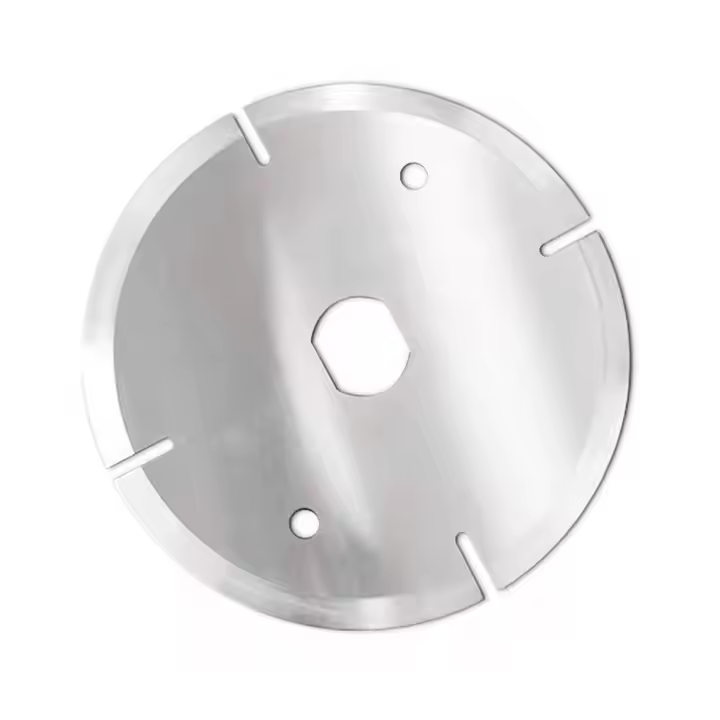
Used in band saws, slicers, and guillotine cutters to portion frozen beef, pork, and lamb blocks into steaks, cutlets, or dices. D2 blades are specified for high-volume lines running 24/7.
Customized sizes are available, according to your drawing or sample.
The frozen meat cutting blade is a precision-ground industrial knife designed for portioning, slicing, and dicing frozen meat, poultry, and fish blocks at temperatures down to -25°C. Engineered for high-volume food processing lines, these blades are typically specified in materials such as AISI 420 stainless steel, D2 (Cr12MoV), or M2 high-speed steel, with a post heat-treatment hardness of HRC 52–60. The combination of a sub-0.1 mm flatness tolerance and a mirror-ground surface finish reduces product adhesion and bacterial harbourage, directly extending production uptime between blade changes.
Achieves HRC 52–60 depending on material grade. D2 (Cr12MoV) variants provide high wear resistance for frozen blocks; 420 stainless offers corrosion resistance for wet, saline processing environments.
Blade body flatness is controlled to <0.1 mm across the cutting plane. This minimises vibration, ensures uniform cut thickness, and reduces noise during high-speed reciprocating or rotary cutting.
A Ra ≤0.2 µm mirror finish on the blade flanks prevents frozen meat adhesion, eases cleaning, and meets typical FDA/USDA hygienic design expectations for direct food contact surfaces.
Material grades and heat-treatment cycles are selected to maintain toughness at sub-zero temperatures, resisting micro-chipping when cutting bone-in frozen poultry or dense frozen fish blocks.
Blades are manufactured to customer-supplied drawings or reverse-engineered from samples. Dimensional ranges cover OD 80–400 mm, thickness 1.5–8 mm, with custom bolt patterns, keyways, and bevel geometries.
More than 50% reduction in knife change
|
Specification
|
|
|
Product name |
Frozen Meat Cutting Blade |
|
Size |
customized |
|
Material |
Stianless Steel 420 or customized |
|
Hardness |
52-60 HRC |
|
Application |
Poultry cutting / Fish cutting |
|
MOQ |
50 pcs |
|
OEM |
Available |
|
After Warranty Service |
Online support |
|
Local Service Location |
None |
|
After sales Service Provided |
Online support |
|
Flatness |
< 0.1 mm |
|
Surface Treatment |
Mirror grinding |
| Dimensions | OD 80–400 mm, ID 20–100 mm, thickness 1.5–8 mm. Length for straight blades up to 600 mm. Custom dimensions per drawing. |
| Materials | AISI 420 (2Cr13), D2 (Cr12MoV), M2 HSS, 440C, tungsten carbide (for specific wear segments) |
| Hardness | HRC 52–60 (420/D2); HRC 58–62 (M2); HRA 89–92 (tungsten carbide inserts) |
| Tolerances | Thickness tolerance ±0.02 mm, flatness <0.1 mm, parallelism <0.02 mm, bore tolerance H7 |
| Surface Finish | Mirror grinding, Ra ≤0.2 µm on cutting faces; optional PVD coatings (TiN, CrN) for extended life |
| Customisation | Manufactured to customer drawing or sample. Specify material, hardness, bevel angle (single/double), mounting hole pattern, and surface treatment. |
YISHI Machinery applies in-house vacuum heat treatment and cryogenic processing to stabilise blade microstructure, achieving consistent HRC values within a ±1 point band across production batches. Blades are ground on CNC surface grinders to maintain flatness under 0.1 mm, a critical parameter for frozen meat cutting where blade deflection causes yield loss. Every blade is dimensionally inspected with a CMM report available on request. We accept OEM orders from 50 pieces with a standard lead time of 15–20 working days, and offer expedited production for urgent line-down situations. No marketing claims—just measurable specifications and repeatable quality.
D2 (Cr12MoV) at HRC 56–60 is typically recommended for bone-in applications due to its high wear resistance and toughness after vacuum heat treatment. For highly corrosive environments or frequent washdowns, 420 stainless at HRC 52–55 may be preferred, though edge life will be shorter.
Yes. Provide a dimensional drawing with tolerances, material grade, hardness specification, and surface finish requirement. If a drawing is unavailable, ship a sample blade and our engineering team will reverse-engineer it, producing a full specification sheet for your approval before manufacturing.
We guarantee flatness <0.1 mm across the blade body. This is verified on a surface plate with a dial indicator and can be documented in a dimensional report. Tighter tolerances down to 0.05 mm are achievable for specific applications at additional cost.
The standard MOQ is 50 pieces per specification. For first-article qualification, smaller trial batches of 10–20 pieces can be arranged with a setup charge. Contact our engineering team with your requirements for a specific quotation.
Yes. PVD coatings such as titanium nitride (TiN) and chromium nitride (CrN) can be applied to increase surface hardness and reduce friction. These are particularly effective on D2 and M2 substrates for high-volume frozen meat lines. Coating thickness is typically 2–4 µm.