
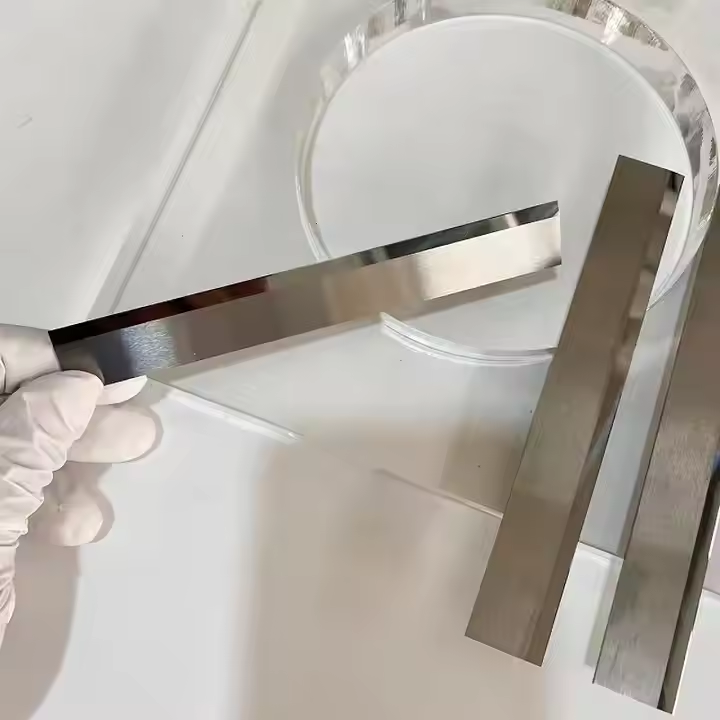
Used in staple fiber cutters to convert continuous filament tow into cut lengths of 32 mm to 102 mm. The blade's edge stability directly impacts the quality of the cut end and the generation of micro-dust.
Customized sizes are available, according to your drawing or sample.
Chemical fiber cutting blades are precision consumables engineered for the high-speed severing of synthetic filament tows and staple fibers. These blades are specified by procurement engineers and maintenance supervisors overseeing polyester, nylon, acrylic, and polypropylene production lines. The primary technical hook is material selection: tungsten carbide grades deliver a hardness of HRC 62-64 for maximum edge retention in abrasive media, while high-speed steel (HSS) variants offer a balance of toughness and regrindability. Dimensional configurations typically include rectangular blades at 110 x 24 x 1.0 mm or 175 x 33 x 1.2 mm, with full customization accepted from customer drawings or OEM part numbers.
Blades are manufactured from micro-grain tungsten carbide, achieving a hardness of HRC 62-64. This substrate provides a wear life 3-5 times longer than conventional tool steel when cutting abrasive materials such as TiO2-delustered polyester.
High-speed steel variants undergo vacuum heat treatment to a typical hardness of HRC 62-64, ensuring uniform grain structure and minimal distortion across the blade length, which is critical for maintaining a consistent cutting gap.
The cutting edge is finished with a precision grinding process, achieving a surface roughness of Ra ≤ 0.2 µm on the bevel. This minimizes fiber adhesion and reduces the force required for a clean cut.
Standard sizes include 110 x 24 x 1.0 mm and 175 x 33 x 1.2 mm. Non-standard lengths, widths, thicknesses, and mounting hole patterns are produced to exact customer specifications, including reverse engineering from a sample blade.
Blades are held to a flatness tolerance of 0.005 mm and a parallelism tolerance of 0.002 mm between the two faces. This ensures uniform clamping pressure across the blade and eliminates vibration at high cutting speeds.
Chemical Fiber Cutting Blades are specialized blades designed for precisely cutting synthetic fibers used in the textile and manufacturing industries. Made from high-quality materials like tungsten carbide or ceramic, these blades offer excellent durability, sharpness, and resistance to wear. They are ideal for applications such as cutting polyester, nylon, and other chemical fibers, ensuring smooth and accurate cuts while maintaining high production efficiency.
| product name | industrial blades |
| size(Support customization) | 110x24x1.0mm |
| 175x33x1.2mm | |
| HRC | 62-64 |
| Material | Tungsten carbide cutting blade |
| Features | High hardness, wear-resistant and durable |
| Outer packaging | cardboard box/wooden box |
| Dimensions | Standard: 110 x 24 x 1.0 mm, 175 x 33 x 1.2 mm. Custom range: Length 50-500 mm, Width 10-100 mm, Thickness 0.5-5.0 mm. |
| Materials | Tungsten Carbide (micro-grain), High-Speed Steel (M2, SKH51), D2 (Cr12MoV) |
| Hardness | Tungsten Carbide: HRC 62-64; HSS: HRC 62-64; D2: HRC 58-62 |
| Tolerances | Thickness: ±0.01 mm; Length/Width: ±0.05 mm; Flatness: 0.005 mm; Parallelism: 0.002 mm |
| Surface Finish | Cutting edge bevel: Ra ≤ 0.2 µm; Blade faces: Ra ≤ 0.4 µm |
| Customisation | Custom dimensions, mounting hole patterns, edge angles, and material grades per customer drawing, sample, or OEM part number. |
YISHI Machinery manufactures chemical fiber cutting blades in-house, controlling the full process from material selection to final inspection. Our vacuum heat treatment furnaces and precision grinding centers are calibrated for the specific tolerances required by high-speed fiber cutting lines. We maintain traceability on every blade lot, linking it to the raw material certificate and process parameters. For replacement blades, we can match your existing OEM part number or reverse engineer from a worn sample, ensuring a drop-in fit without modifying your cutter setup. Expedited production is available for urgent line-down situations.
In abrasive applications, such as cutting TiO2-delustered polyester, tungsten carbide blades typically last 3-5 times longer than HSS blades between regrinds. However, HSS blades are less brittle and can be reground more times over their total lifespan. The choice depends on the specific fiber type and the presence of abrasive additives.
Yes. We manufacture replacement blades for common OEM cutter models from manufacturers like Fleissner, Neumag, and DM&E. Provide the OEM part number or a dimensional drawing, and we will produce a blade that matches the original specification for a drop-in fit.
A typical edge angle for polyester staple fiber is between 18 and 22 degrees. The exact angle can be optimized based on the fiber denier and tow density. Our engineering team can recommend an angle based on your process parameters or match the angle on your current blade sample.
Standard lead time for custom chemical fiber cutting blades is 15-20 working days from drawing approval. For urgent requirements, an expedited production service is available that can reduce lead time to 7-10 working days, subject to material availability and current production load.
Blades should be stored in their original VCI-protected packaging in a dry, temperature-controlled environment. Individual blade separators are used to prevent edge-to-edge contact. Avoid any storage condition that exposes the blades to humidity or corrosive atmospheres, which can cause micro-pitting on the cutting edge.