
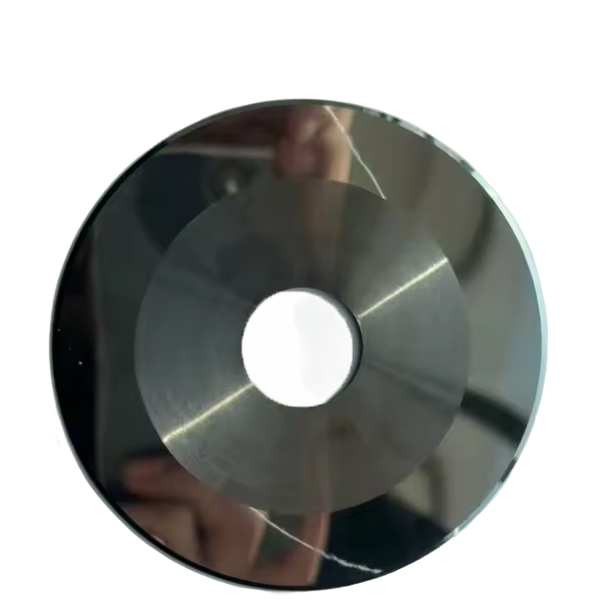
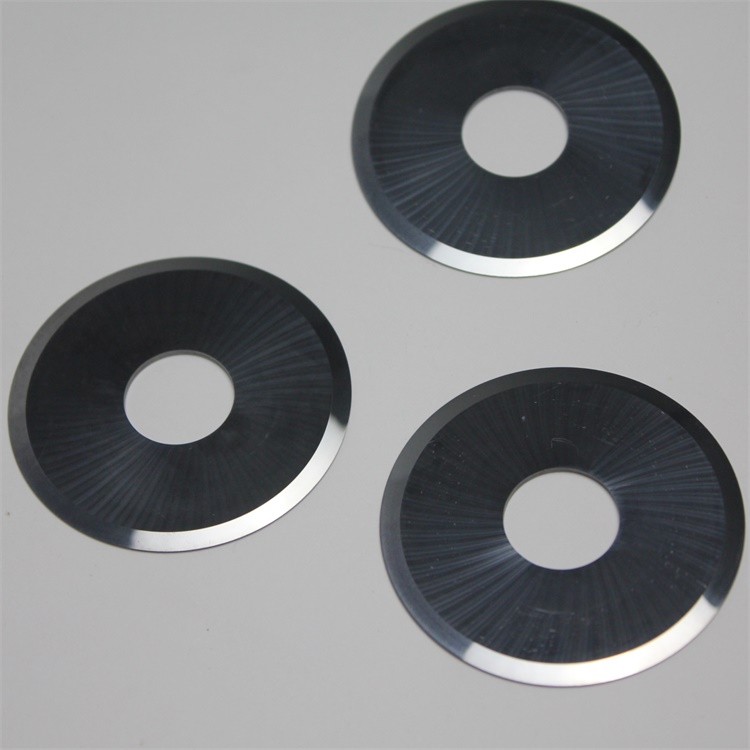
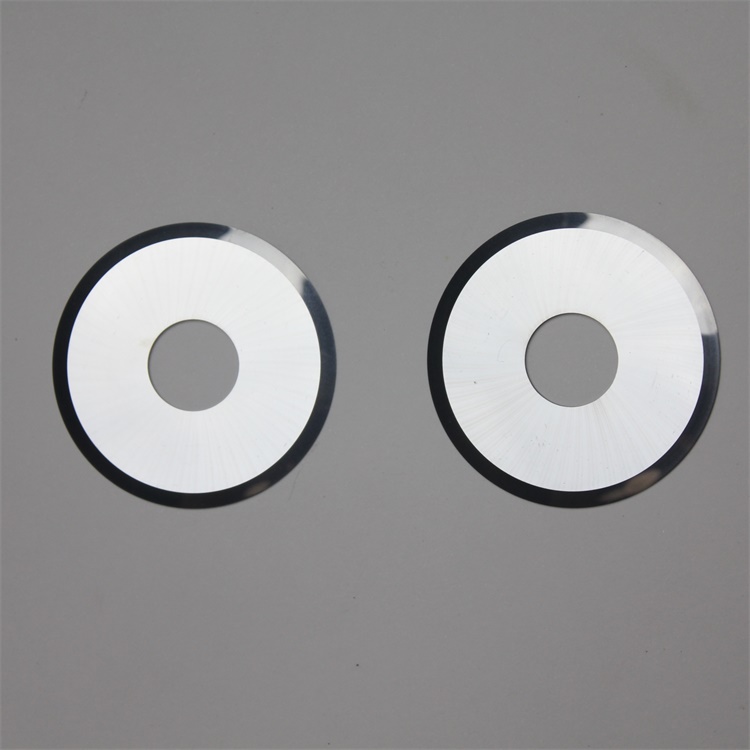
Top and bottom slitter blades for sheeting and slitting lines processing thermal paper, kraft paper, and lightweight coated papers. D2 blades at HRC 60–62 provide the edge stability needed for dust-free cuts on high-speed rewinders.
Customized sizes are available, according to your drawing or sample.
The alloy slitter blade is a precision circular knife engineered for continuous longitudinal slitting of paper, film, foil, and nonwoven webs. Designed as a direct replacement or upgrade for OEM tooling on slitter rewinders and converting lines, these blades are manufactured from high-alloy tool steels including D2 (Cr12MoV), M2 high-speed steel, and H13, with hardness values ranging from HRC 58 to 65 after vacuum heat treatment. The combination of tight dimensional tolerances, typically within ±0.005 mm on thickness, and a fine-ground cutting edge ensures clean, burr-free cuts and extended service intervals in high-cycle production environments. Procurement engineers can specify outer diameters from 60 mm to 150 mm, bore sizes to match arbor requirements, and thicknesses as low as 0.5 mm, with full customisation accepted against drawings or physical samples.
Available in D2 (Cr12MoV) for general-purpose wear resistance, M2 HSS for high-temperature edge retention, and H13 for tougher applications. Hardness is controlled to HRC 58–62 for D2 and HRC 62–65 for M2, ensuring a balance of toughness and cutting performance.
Thickness tolerance is held to ±0.005 mm and parallelism to within 0.002 mm for standard blades. Bore tolerances are machined to H7 or as specified, ensuring consistent runout and minimal vibration at line speeds exceeding 300 m/min.
Blade edges are ground to a surface finish of Ra 0.2–0.4 µm, with standard edge angles of 30°, 45°, or 60° available. Custom edge profiles, including single-bevel, double-bevel, and radiused edges, are produced to match specific material separation requirements.
Non-standard OD/ID/thickness combinations, keyways, pin holes, and countersunk mounting features are machined in-house. Blades can be reverse-engineered from a worn sample or produced to a customer-supplied 2D drawing with a 3D CAD model provided for approval before production.
Physical vapour deposition (PVD) coatings such as TiN, TiCN, and AlCrN are applied to increase surface hardness above HV 2500 and reduce friction coefficients, particularly beneficial when slitting abrasive or adhesive-coated substrates.
It has a variety of materials to choose from, sharp and wear-resistant, and supports customization.
|
Product Name |
Alloy Slitter Blade
|
|
Size (mm)
|
60x40x1 100x66x0.8 100x70x1.2 102x75x1 105x70x1.2 |
|
62x35x0.5 100x66x1 100x75x1.2 105x65x1.2 105x70x1.5 |
|
|
65x40x0.6 108x75x1.2 110x75x1.2 142x116x1.2 150x80x2.2 |
|
|
65x40x1 70x28x12 70x45x3 70x45x8 80x50x8 |
|
|
68x46x0.5 90x60x10 90x65x10 105x60x15 150x120x12 |
|
|
70x40x1 80x50x10 80x55x10 90x65x8 150x120x15 |
| Dimensions | Outer diameter: 60–150 mm; inner diameter: 25.4–120 mm; thickness: 0.5–15 mm. Common sizes include 100×66×1 mm, 105×70×1.2 mm, and 150×80×2.2 mm. Non-standard dimensions manufactured to order. |
| Materials | D2 (Cr12MoV), M2 HSS, H13, SKD11, 9CrSi, tungsten carbide (upon request) |
| Hardness | HRC 58–62 (D2/SKD11), HRC 62–65 (M2 HSS), HRC 50–54 (H13). Carbide grades available with HRA 89–92. |
| Tolerances | Thickness: ±0.005 mm; parallelism: ≤0.002 mm; bore: H7 standard; runout: ≤0.01 mm. Tighter tolerances available on request. |
| Surface Finish | Cutting edge: Ra 0.2–0.4 µm; blade faces: Ra 0.4–0.8 µm. Mirror finish (Ra ≤0.05 µm) available for adhesive-sensitive applications. |
| Customisation | Buyers can specify OD, ID, thickness, edge angle, coating type, keyway dimensions, pin holes, and countersinks. Submit a drawing, sample blade, or OEM part number for a matched replacement. |
YISHI Machinery operates an in-house heat treatment facility with vacuum furnaces, enabling precise control of hardness profiles and minimising distortion on thin-gauge slitter blades. All blades are inspected with a 0.001 mm resolution micrometer and a surface roughness tester, with inspection reports provided upon request. Engineering support includes material selection guidance based on your substrate type and line speed, and a CAD-confirmation step before production. Expedited lead times are available for standard semi-finished blanks, and no minimum order quantity is enforced for custom prototypes.
For abrasive paper or coated stocks, D2 (Cr12MoV) at HRC 60–62 is typically recommended due to its high chromium content (11–13%) which provides excellent wear resistance. If heat build-up is a concern at high line speeds, M2 HSS offers better hot hardness and can maintain its cutting edge at elevated temperatures.
Yes. We can reverse-engineer a blade from a worn sample by measuring the OD, ID, thickness, and edge geometry on a coordinate measuring machine (CMM). We then produce a CAD drawing for your approval before manufacturing. Providing the OEM machine model and original part number, if available, helps expedite the process.
Standard custom blades are produced within 15–20 working days after drawing approval. For urgent requirements, we maintain a stock of semi-finished blanks in common D2 and M2 grades that can be finish-ground and shipped in 7–10 working days. Coated blades require an additional 3–5 days for PVD processing.
The standard bore tolerance is H7, which provides a precise sliding fit on most arbors. If your application requires a tighter interference fit or a specific clearance, you can specify the exact bore dimension with a unilateral or bilateral tolerance on your drawing. We also machine keyways to DIN 6885 or customer-specified standards.
We offer TiN (gold), TiCN (grey), and AlCrN (dark grey) PVD coatings. TiN is a general-purpose coating that reduces friction and adhesive wear. TiCN provides higher hardness (HV ~3000) for abrasive materials. AlCrN is recommended for high-temperature applications as it maintains hardness up to 900°C, making it suitable for dry slitting or high-speed lines.
A dimensional inspection report covering OD, ID, thickness, parallelism, and bore tolerance is available upon request. Hardness testing is performed on a sample basis per heat treatment lot using a calibrated Rockwell hardness tester, and the results can be included in the shipment documentation.